
My Argument: Pressure Is the Enemy of a Settled Dog
As a certified professional, I shifted my initial consultation focus entirely away from obedience commands after tracking how many new dog moms were crying out of frustration by day four. We often bring a new dog home with a vision of instant connection. When reality looks like pacing, panting, or hiding, panic sets in.
The first week is a relationship-building window, not a training deadline.
Biology dictates this pace. Acute stress hormones like cortisol and adrenaline take roughly two to three days to fully clear from a dog's bloodstream after a major transition. Asking a dog to learn new rules while their body is flooded with stress chemicals is like trying to teach algebra during a fire alarm.
What 'Pressure' Actually Looks Like (Even When You Mean Well)
What I've observed supports that our warmest intentions often backfire. I categorized common welcoming behaviors by analyzing intake videos from clients. Actions meant to show love—like direct eye contact and leaning over the dog—were consistently triggering stress signals.
We also put immense emotional pressure on ourselves. We want immediate proof that we made the right choice in adopting. That desperation for a bond translates into hovering, over-petting, and forcing affection before trust exists.
Pro Tip: Limiting the dog's access to just 1 or 2 quiet rooms during the first few days prevents spatial overwhelm.
The Decompression Timeline: A Loose Map, Not a Schedule
Initially, I tried giving clients a strict day-by-day milestone checklist for the first month. I abandoned it when I saw it creating more anxiety than clarity. Now, I adapt the standard 3-3-3 rescue guideline into a qualitative framework.

Every dog's timeline differs based on history and temperament. A former street dog transported from a rural environment will require a vastly different, much slower sensory introduction to a home than an owner-surrender accustomed to indoor living.
Watch for positive signs like relaxed body language and voluntary engagement. A newly rehomed dog in active decompression often needs somewhere around 14 to 18 hours of uninterrupted sleep per 24-hour cycle to recover from environmental shock.
'But Won't I Be Reinforcing Bad Habits?' — Addressing the Objection
Clients frequently worry that patience equals permissiveness. They fear that skipping obedience on day one guarantees a spoiled dog.
Decompression is about establishing safety and trust. It does not mean abandoning structure.
A better approach replaces verbal corrections with passive environmental management. Using physical barriers around three feet tall, such as baby gates or exercise pens, manages access to high-value items rather than relying on the 'leave it' command. This ensures boundaries exist without adding social pressure.
The Part Nobody Tells You: Your Nervous System Sets the Tone
Dogs co-regulate with their guardians. Your anxiety becomes their anxiety.
Group feedback suggests that a handler's shallow, rapid breathing tends to track with their new dog's inability to settle on a mat. You have permission to feel underwhelmed or anxious in the early days without guilt. Acknowledging your own stress is the first step toward helping your dog.
Key Takeaway: Try a handler breathing pattern of 4-second inhales and 6-second exhales for two minutes before opening the dog's crate or initiating a walk.
What I'd Do Instead During Week One
I designed the week-one protocol around sensory reduction. Instructing guardians to act as neutral fixtures in the room rather than active entertainers helps lower the dog's cognitive load.
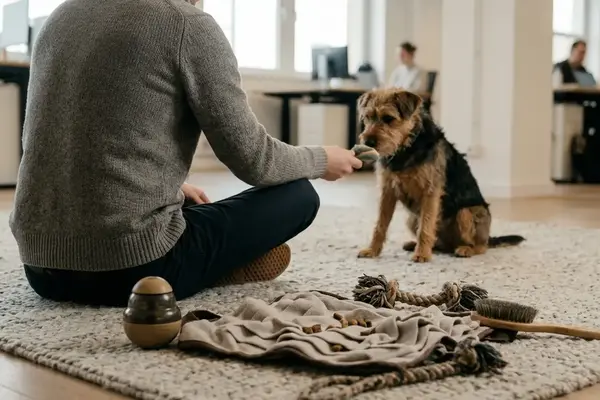
Sit quietly 6 to 8 feet away from the dog's resting area with a book or laptop. Avoid direct eye contact or reaching out. Let them choose to approach you.
Warning: A dog shutting down completely and freezing is a common failure case. Well-meaning guardians often misinterpret this as the dog being 'calm' or 'well-behaved' rather than deeply overwhelmed.
For more foundational steps, review the ASPCA guidance on helping a new dog settle in.
Picture the first two weeks as the dog quietly learning that nothing here is a test: a steady rhythm of food, rest, and short unhurried walks, with no crowding and no demands. Give a stable dog that runway and its real personality usually surfaces by the third week. The one exception worth naming out loud is genuine panic or active resource guarding, not ordinary nerves: that is a job for a qualified behaviorist now, because time alone will not resolve it.







Leave a Comment