
What This Guide Covers
Quick Nav
- Why a Journal Beats Relying on Memory
- Inside the Growing & Heeling Journal: The Core Sections
- Setting Up Your Journal in 4 Steps
- Logging Reactivity and Trigger Patterns
- Reading Your Data: Weekly and Monthly Reviews
- What the Journal Can — and Can't, Do
Building a life with your dog isn't about perfection. It is about showing up, day after day, for both of you. Whether you are navigating a reactive pup, adjusting to a newly adopted rescue, or just learning to trust yourself as a dog mom, you are not doing this alone.
This guide breaks down how to use a behavior journal to track measurable progress. We frame the journaling process as a low-pressure weekly habit rather than a daily requirement to actively prevent guardian burnout and guilt. You will learn how to set up your pages, what specific metrics actually matter, and how to read your own notes to find the quiet victories hidden in plain sight.
Why a Journal Beats Relying on Memory
Progress with reactive or anxious dogs is rarely linear. When you rely solely on memory, your brain plays tricks on you. Group feedback indicates that memory exaggerates bad days and completely erases small wins.
A difficult walk on Thursday can make you feel like the last three months of training were entirely useless. Written records turn vague feelings of failure into specific, fixable data. Instead of concluding that your dog was simply "bad at the park," a journal helps you document that they reacted at 15 feet, not 5 feet like last month. By tracking trigger distances down to small increments, you create a clear record of change.
This practice protects your mental health. It makes slow improvement visible and validates the immense effort you put into your dog's well-being every single day.
Inside the Growing & Heeling Journal: The Core Sections

A functional journal needs structure. Blank pages invite rambling, which quickly leads to burnout. We initially considered a detailed 10-point behavioral scale for this system, but rejected it in favor of a simple 1-5 intensity rating to ensure guardians actually complete the log during stressful post-walk moments.
Your journal should contain three core sections:
- Daily Snapshot: Record the date, weather, and a quick mood rating for both you and your dog.
- Trigger Log: Document what set your dog off, the distance, the intensity (1-5), and the recovery time. Recovery time is measured in seconds or minutes, such as about 45 seconds to re-engage.
- Win Column: Write down one small success per entry. It does not matter how tiny it is. Taking a treat near a trigger counts.
| Section | Purpose | Example Entry |
|---|---|---|
| Daily Snapshot | Establish baseline mood and environment | Rainy, 65F. Dog: Anxious (2/5). Me: Rushed (3/5). |
| Trigger Log | Track reactivity thresholds and intensity | Skateboarder at 20ft. Intensity: 4. Recovery: 45 sec. |
| Win Column | Highlight micro-progress and build confidence | Looked at me immediately after the skateboard passed. |
Setting Up Your Journal in 4 Steps
Starting a new tracking habit requires intention. Many guardians end up abandoning the journal after a few days due to overly complex paragraph-style entries. Keep it brief.
- Choose a baseline week. Log everything exactly as it is before changing any of your handling techniques. Start with a baseline week so you understand your true starting point.
- Define measurable goals. Pick two or three specific targets. "Pass a leashed dog at 10 feet without lunging" is measurable. "Be better on walks" is not.
- Pick a consistent logging time. The best time is immediately after walks or training sessions while the details are still fresh in your mind.
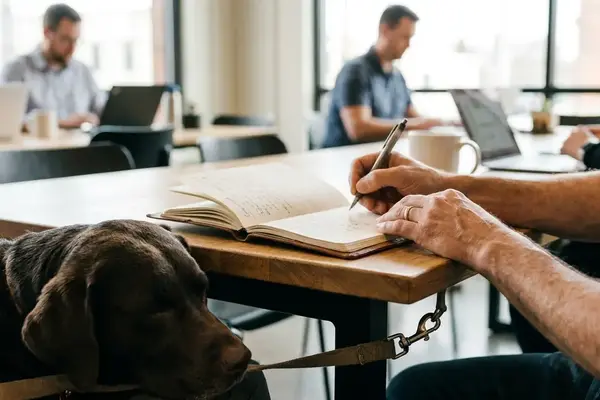
- Prepare your environment. Keep the journal and a pen right next to your leash station.
Pro Tip: Do not force yourself to write on days when you are completely overwhelmed. Leave the page blank and try again tomorrow. Consistency matters more than perfection.
Logging Reactivity and Trigger Patterns

It helps to draw a clear distinction between the "notice" threshold and the "reaction" threshold. Your dog noticing a trigger (ears up, staring) is entirely different from reacting to it (barking, lunging). Documenting this gap helps you identify the exact window for positive reinforcement.
Pay close attention to how long it takes your dog to shake off a stressful event. Training logs show recovery time fluctuating based on trigger stacking from earlier in the day. If your dog barked at the mail carrier at 9 AM, their recovery time from seeing a squirrel at 2 PM might be significantly longer.
Always note environmental variables. Time of day, fatigue, hunger, and even wind direction change the behavioral picture. A reaction at 10 feet on a quiet morning is different from a reaction at 10 feet during rush hour.
Reading Your Data: Weekly and Monthly Reviews
Data collection is only half the process. You need to review your notes to spot the trends.
Set up your review so you read the win column first. This intentionally resets your mindset before you analyze plateau data or difficult walks. Once you feel grounded, compare your trigger distances and recovery times across the weeks.
Look for plateaus. Think of a plateau as roughly three to four weeks of no measurable change in threshold distance. A plateau is not a failure. It is simply a signal that your current training plan needs a slight adjustment.
Key Takeaway: Celebrate the shrinking recovery times. A dog that still barks but recovers in 30 seconds instead of 5 minutes is making massive behavioral strides.
What the Journal Can — and Can't, Do
A journal is a tracking and reflection tool. It is not a behavior diagnosis or a full treatment plan.
Self-reported mood ratings are subjective by design. They track your personal emotional trend, not a clinical measure of canine neurochemistry. Use the journal to guide your conversations with professionals, not to replace them.
Warning: Severe reactivity, aggression, or sudden behavior changes warrant a certified behaviorist or veterinary visit. One catch: this journaling method relies on the handler's ability to safely observe the dog's body language; if reactions are so severe that physical safety is compromised, logging must be paused until a certified behaviorist intervenes.
Keep logging, keep breathing, and remember to look at how far you both have come.









Leave a Comment