
Quick Nav
- Why journaling belongs in your dog-mom toolkit
- How these prompts were chosen
- Prompts for building your confidence
- Prompts for reactive-dog days
- Prompts for deepening the bond
- Prompts for your own mental well-being
- Turning prompts into a sustainable practice
Why Journaling Belongs in Your Dog-Mom Toolkit
Dog guardianship carries an emotional load that does not always show up in the training plan.
There is the walk that looked fine from the outside but left your shoulders tight for an hour. The vet visit where your dog trembled and you smiled too hard at the receptionist. The reactive moment on the sidewalk that made you want to disappear, even though your dog recovered faster than you did.
Reflective journaling gives that experience somewhere to land. Not as homework. Not as another daily task you can “fail” at. Think of it as a low-pressure self-check-in, the way you might glance at your dog’s body language and ask, “What is happening here?” only this time, the question includes you.
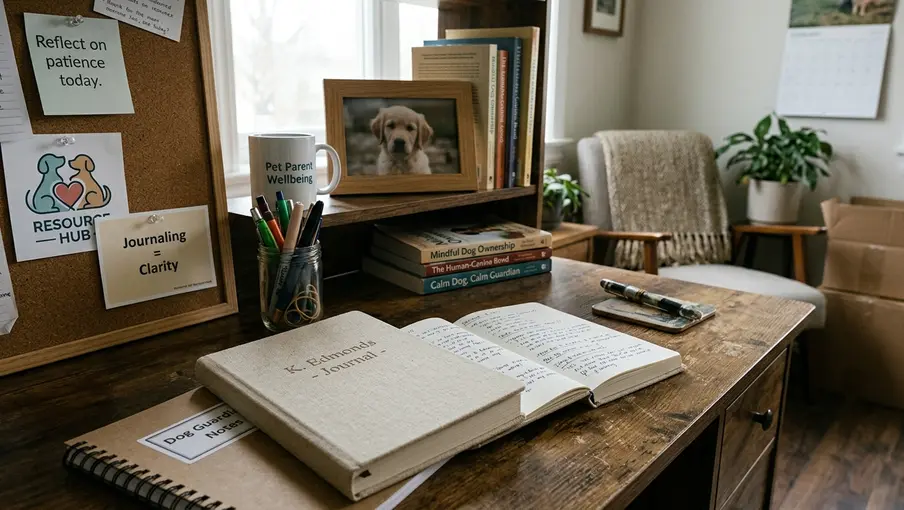
The prompts below are sorted into four themes, so you can jump to the one that matches the day you are actually having. Confidence. Reactivity. Bonding. Your own well-being.
Key Takeaway: Journaling works best when it lowers the pressure in your system, not when it becomes one more standard to meet.
How These Prompts Were Chosen
These prompts were chosen with three filters: each one is open-ended, emotionally specific, and tied to a real dog-guardian situation. No yes-or-no questions made the cut, because a useful prompt should give you enough room for a few sentences.
Field experience revealed that sorting prompts by dog age or breed missed the point. A senior dog, a teenage rescue, and a nervous puppy can all bring up the same ache in a guardian: embarrassment, guilt, uncertainty, tenderness, exhaustion. So the prompts are organized by the guardian’s emotional task, not the dog’s demographic category.
Use them simply. Pick one prompt. Write for five minutes. Do not edit while you write.
Prompts avoid clinical jargon on purpose. You do not need to label every feeling with perfect precision before it deserves care. Sometimes “I felt small after that walk” is the most honest sentence on the page.
Pro Tip: If a prompt makes you spiral into replaying your dog’s “mistakes,” pause and write this instead: “What did my nervous system need in that moment?”
Prompts for Building Your Confidence (1–5)
Confidence does not usually arrive as a grand personality change. More often, it grows from noticing the ordinary moments where you made a reasonable choice with the information you had.
These prompts focus on roughly a day’s recall window, which keeps the writing close to real events instead of drifting into a full history of every hard walk you have ever taken.
1. What did I notice about my dog today that helped me make a better choice?
This prompt trains attention toward your own judgment. Maybe you crossed the street early, shortened the walk, or skipped a greeting because your dog’s tail, ears, or breathing told you enough.
2. If today’s hardest walk were just one scene, not the whole story, what else would I include?
A bad walk can take over the entire day if it gets the first and last word. This question widens the frame without pretending the hard part did not happen.
3. What small win would I miss if I only looked for perfect behavior?
Small wins count. Your dog looked away from a trigger. You unclipped the leash calmly at home. You both made it back to the car without snapping at each other.
4. What is one thing I consistently do well as my dog’s guardian?
Write the answer plainly. You do not have to soften it with “but.” If you show up, learn patterns, refill meds, manage gates, advocate at the vet, or protect your dog’s space, that belongs on the page.
5. How can I separate my worth from my dog’s public behavior?
This one matters after the sidewalk stare, the bark in the waiting room, or the neighbor comment that landed badly. Your dog’s behavior is communication and learning history. It is not a public report card on your goodness.
Prompts for Reactive-Dog Days (6–10)
Reactivity is a behavior, not a character flaw. That sentence may need to be written more than once.
On reactive-dog days, the guardian’s body often holds the story long after the dog has moved on. These prompts center both sides of the leash: what your dog experienced, and what happened inside you.
6. What feeling came up for me after my dog reacted, and where did I feel it in my body?
Embarrassment may sit in the face. Fear may tighten the stomach. Anger may show up as a clenched jaw before you even know you are angry.
Naming the body response is not overthinking. It is information.
7. What triggers did I notice today, and how can I describe them without judging my dog?
Try concrete language: a dog appeared across the street, a scooter passed a short distance away, a person reached toward the fence. Neutral notes protect you from turning “my dog struggled” into “my dog is impossible.”
8. What did I do to help my dog recover, and what helped me recover?
Your dog may need distance, sniffing, food scatter, or quiet. You may need slower breathing, fewer explanations to strangers, or ten minutes in the driveway before going inside.
Some dogs take ten or fifteen minutes to settle after a reaction. Some guardians do too.
9. What part of today showed de-escalation, even if it was messy?
De-escalation is not always graceful. It may look like turning around, dropping treats on the ground, stepping behind a parked car, or saying “not today” and leaving.
That still counts as care.
10. What is one adjustment that could make the next outing calmer?
Keep this answer small enough to use. A different route. A wider visual buffer. A shorter walk after trash pickup. A plan to skip greetings before your dog is already over threshold.
Warning: Journaling becomes counterproductive if it turns into a courtroom where you prosecute every training failure. Use the page to process your response, not to relive the whole walk on repeat.
Prompts for Deepening the Bond (11–15)
Bonding with a dog is not limited to big milestones. It often happens in interactions lasting under a minute: a sigh of relaxation, an ear flick when you say their name, the way they lean into your leg while the coffee brews.

These prompts invite presence. They are less about evaluating progress and more about noticing companionship while it is still warm.
11. When did my dog seem to feel safe with me today?
Look for the small tells. Soft eyes. Loose muscles. Choosing to rest near you. Taking a treat gently after a stressful sound.
12. What did play teach me about my dog today?
Play is not just exercise. It can show you confidence, hesitation, humor, frustration tolerance, and the exact moment your dog needs a pause.
13. What is one non-verbal way my dog and I communicated?
Maybe your dog paused at the corner and you understood. Maybe you shifted your shoulders and they followed. These quiet exchanges are easy to miss because nobody claps for them.
14. What quirk am I grateful for, even if it makes life a little inconvenient?
The sock parade. The dramatic flop. The inspection of every grocery bag. Gratitude does not require pretending a habit is always easy; it asks you to notice the beloved shape of this particular dog.
15. If my dog could describe me with kindness, what might they say?
This prompt can feel tender, especially for guardians who are hard on themselves. Let your dog’s imagined voice be simpler than your inner critic: “She comes back.” “She tries.” “She knows where I like to be scratched.”
Prompts for Your Own Mental Well-Being (16–20)
High-needs dog guardians can become very skilled at tracking the dog and very unpracticed at tracking themselves.
These prompts are for the day or two after a high-stress training setback, a hard appointment, or one of those weeks where every routine feels heavier. For this kind of reflection, timing and nervous-system state matter as much as the words on the page.
16. What guilt am I carrying, and what would self-compassion say back?
Guilt often speaks in absolutes: “I should have known,” “I ruined it,” “I am not doing enough.” Self-compassion does not erase responsibility. It makes repair possible without shame running the room.
17. What kind of rest would help me recharge without abandoning my dog’s needs?
Rest may be a shorter enrichment plan, a delivery order, asking someone else to handle the evening potty trip, or choosing a quiet sniff walk instead of training drills.
You are allowed to design care that includes you.
18. Who is in my support system, and what can I ask from each person?
Be specific. One person may be good for a practical ride to the vet. Another may understand the crying-after-class feeling. Another may simply send memes and not try to fix anything.
19. What fear have I outgrown as a dog guardian?
This prompt often reveals progress you stopped celebrating. Maybe you can advocate at the groomer now. Maybe you no longer panic at every bark. Maybe you trust yourself to leave a situation before it gets worse.
20. What does “good enough” look like for me and my dog this week?
Good enough is not neglect. It is a humane standard for real life.
This week, it might mean medication given on time, safe walks, meals, affection, and one moment of play. During a regression week, the answer may look different than it does during steady progress. How well a prompt lands depends on your dog’s current training phase and your own capacity that day.
Key Takeaway: Journaling supports reflection, but it is not a substitute for professional mental-health care or veterinary behavior support when anxiety, fear, or safety concerns are severe.
Turning Prompts Into a Sustainable Practice
The easiest journaling habit is the one attached to something you already do.
Try a few quiet minutes of cooldown after removing your dog’s harness. Set the leash down. Give your dog water or a chew if that fits your routine. Then write one prompt before your brain starts negotiating with the rest of the day.
You can also pair journaling with bedtime, the first coffee, the post-vet parking lot pause, or the ten quiet minutes after a training class. The time of day matters less than the cue that tells your body, “We are checking in now.”
Skip days. Revisit prompts. Answer the same question during a hard month and again when things feel steadier. You are not building a perfect archive; you are building a kinder way to stay in conversation with yourself.
Progress with a dog rarely moves in a clean line. Neither does confidence. But a few honest sentences can help you notice what is working, where you are hurting, and how much love is already present in the ordinary work of showing up.










Leave a Comment