

What a Confidence Folder Actually Is
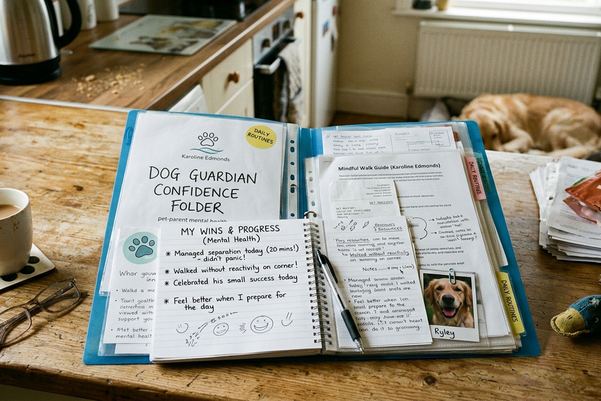
A confidence folder is a personal collection of evidence for the days when your brain insists that you and your dog are failing. It can hold photos, short notes, encouraging messages, videos, grounding exercises, and reminders of what to do when a walk goes sideways.
The format does not matter. Use a physical folder, a favorite album on your phone, a pinned note, or a mix of all three. What matters is whether you can reach it quickly with one hand while holding a leash, sitting in the car, or coming through the front door with your heart still pounding.
Karoline structured the idea after recognizing a practical problem: positive thoughts can feel inaccessible during a reactive episode because the body is busy responding to stress. Asking yourself to manufacture confidence in that moment is too much work. Externalizing it changes the task. You do not have to summon belief from scratch; you only have to open the folder.
Key Takeaway: A confidence folder turns progress into something retrievable, not something you must remember perfectly under pressure.
Why This Works When a Walk Falls Apart
A lunge can shrink an entire month of progress into one ugly second. Add a barking dog across the street, a tangled leash, or a stranger offering judgment from the sidewalk, and the story arrives fast: We are making zero progress.
That story feels convincing because stress narrows attention. Your mind grabs the loudest and most recent event while quieter evidence disappears from view. Cortisol and adrenaline also remain in the system after the trigger has passed, so the body may still feel under threat even when you are already home.
The folder interrupts that spiral with prepared, external evidence. You are not debating your frightened brain. You are giving it a calm moment to look at, a sentence to hold, and a next action to take.
This is reactive dog support for the guardian, not a substitute for ongoing care. Persistent anxiety, panic, or depression deserves support from a qualified mental-health professional. Repeated or escalating behavior concerns call for a certified trainer or behavior consultant who can assess the dog in context. The folder helps you return to steady enough to use that support well.
Your dog had a hard moment. You had a hard moment. Neither statement means the whole plan is broken.
Step 1: Collect Your Wins and Proof of Progress
Start with evidence that is concrete enough to survive a bad mood. A photo of your dog asleep after a decompression walk works. So does a trainer's text, a short video of a successful recall, or a note saying, We saw the terrier and crossed the road before barking started.
The original approach focused on perfect, trigger-free walks. That left too little to save and quietly reinforced the idea that only flawless outings counted. The better standard is neutrality: one glance at a trigger followed by disengagement, a brief stretch of loose leash, or the first time your dog rested while another dog existed at a safe distance.
Small wins belong here on purpose. They are usually the first facts self-doubt deletes.
Prompts to Copy Into Your Folder
- Three things my dog can do now that they could not do three months ago.
- One moment I handled well, even if the rest of the walk was difficult.
- A trigger my dog noticed without escalating.
- A choice my dog made that showed recovery, curiosity, or trust.
- Something I did to protect my own pet parent wellbeing.
Be specific. Replace good walk with passed the school fence at a comfortable distance and checked in twice. Specific evidence gives a spiraling mind less room to dismiss it.
Confidence Folder Starter Checklist
- Create a dedicated album on your phone or grab a physical folder.
- Add three photos of your dog sleeping or completely relaxed.
- Save one message from a trainer, vet, or friend praising your dog.
Pro Tip: Include peaceful photos that have nothing to do with training & play. Your relationship is larger than your current behavior goal.
Step 2: Add the Words That Steady You
Use your own language before reaching for inspirational quotes.
A folder filled with toxic positivity can feel alienating during a real crisis. Every day is a gift does not help much when you are crying in the car after an explosive walk. Write what you would say to a close friend in the same situation: direct, kind, and believable.
Build Useful Reframes
- Spiral: We ruined all our progress.Steadier words: One reaction does not erase learned skills.
- Spiral: Everyone thinks I am a bad dog parent.Steadier words: The people passing us do not know our plan.
- Spiral: I should have handled that perfectly.Steadier words: I noticed the problem and got us out.
Save encouragement from your vet, trainer, or another dog parent too. Date those messages. A note from early new dog parenthood carries different weight when you can compare it with what your dog manages now.
Write a Hard Day Letter
Write this while you are regulated. Address the version of you who has just come home shaking. Name what remains true: your dog is more than the lunge, turning around was allowed, management is not failure, and tomorrow does not need to repay today's difficulty.
Keep the letter short enough to read with a tired brain. One screen is plenty. Generic motivation asks you to perform optimism; a letter from calm-you offers recognition.
Step 3: Build In Grounding and Reset Tools

The Reset section needs tools that work while you are standing, watching the environment, and holding a leash. This is not the moment for an exercise that requires closing your eyes or sitting on the pavement.
A Leash-in-Hand Reset
- Create distance from the trigger. Cross the street, step behind a parked car, turn into a driveway, or leave the area.
- Plant both feet and loosen your shoulders without loosening your grip on the leash.
- Take a slower exhale than inhale while continuing to scan for safety.
- Name five things you see, four things you feel, three things you hear, two things you smell, and one thing you can taste.
- Decide whether to continue, change the route, or end the walk.
You can also save a regulating playlist, a photo that settles you, or a short voice note recorded on a calm day. Journaling & resources only help if they are usable in the actual setting, so test each tool with your shoes on and leash in hand.
Warning: If your dog's reactivity involves severe bite risk or immediate danger to your dog, another animal, or a person, physical management and safety protocols take absolute precedence over grounding mid-walk. A frustrated greeter and a dog showing fear-based aggression may look similarly loud from a distance, but they require different safety decisions.
Preselect Your People
Add one or two contacts under a heading such as Who I Can Text. Include the exact message you can send: We had a rough reaction. I am safe, but I need a steady voice for a minute.
Reaching out becomes much easier when the wording and recipient are already chosen.
Step 4: Organize It So You'll Actually Use It
Use three sections only: Proof, Words, Reset. That structure removes a decision at the exact moment decision-making feels hardest.
- Proof holds photos, videos, progress notes, and saved messages.
- Words holds reframes, encouragement, and your hard day letter.
- Reset holds grounding instructions, the mid-walk action plan, music, and contacts.
Make the folder hard to lose. Pin the note. Favorite the album. Put the physical version near the leash station or somewhere you pass every day. Do not bury it inside an elaborate productivity system that requires several taps and a password you never remember.
Add one item after a genuinely good moment. Then review the folder occasionally and remove words that no longer feel useful. Maintenance should feel lighter than training.
I use a blunt test for every entry: can this help a flooded person within seconds? If not, it belongs in a journal, not the quick-access folder.
Using the Folder When You're Actually Struggling
Picture the return home after a reactive episode. Your dog lunged at another dog near the corner. You created distance and ended the walk, but now your hands are shaky. Your dog has already started sniffing around the kitchen while your mind is replaying the scene.
Open the folder before the self-blame narrative gathers speed.
Follow Reset, Words, Proof
- Reset: Put the leash away, feel your feet on the floor, and complete one brief grounding exercise. Let the body begin settling before asking the mind to process language.
- Words: Read one reframe or the first paragraph of your hard day letter. Do not scroll for the perfect sentence.
- Proof: Open one photo, video, or note showing what remains true about your dog's progress.
This order matters. Reading demands more cognitive effort than breathing, orienting, and noticing physical contact with the floor. Ground first. Then ask words and evidence to do their jobs.
The folder may not erase the day. That is not the benchmark. The useful question is whether it helps you return to steady sooner, avoid punishing yourself, and make the next safe decision. Sometimes that decision is a quiet evening, a shorter outing tomorrow, or sending your trainer a factual account of what happened.
Do not turn the folder into another test you can fail. Opening it and reading one line counts.
Where to Start Today
Do not build the whole folder tonight. Perfection is especially expensive when caregiver burnout has already drained your attention.
Open your phone now. Create an album and add three photos of your dog at their calmest: sleeping in a patch of sun, resting after a sniffy walk, or leaning against you on the sofa. Name the album Confidence Folder and favorite it.
A three-item folder you will open is more useful than a polished system you keep postponing. Your progress is real even when a hard walk makes it temporarily invisible, so start with those three photos and keep the receipts.










Leave a Comment