
I bought the notebook at 9:30 PM from a local pharmacy, standing under fluorescent lights with a tight jaw and a leash still looped around my wrist.
It was a 99-cent, 80-page, college-ruled spiral notebook. Nothing pretty. Nothing planned. I did not buy it because I felt hopeful. I bought it because the digital spreadsheet I had tried after our walks kept me staring at a screen while my body was still buzzing, and that seemed to keep my heart rate up instead of helping me come down.
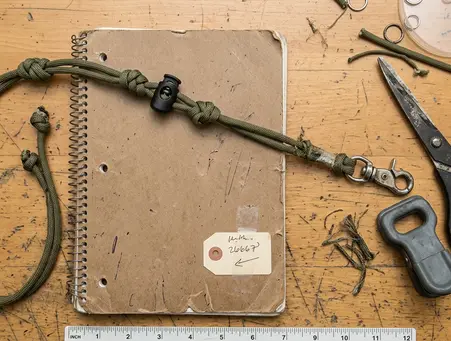
The notebook did not fix my reactive dog. It did not make every walk calm, erase his triggers, or turn me into the kind of guardian who floats down the sidewalk with loose shoulders and endless patience.
What it changed was how I showed up for both of us.
This is one guardian’s field note, not a clinical prescription. If you are living with a dog who barks, lunges, freezes, or scans the world like danger might step out from behind every parked car, I want to tell you what writing did for my nervous system, my decision-making, and our bond.
The Notebook I Didn't Think I Needed
The first page was not elegant. I wrote too hard, denting the paper underneath. I listed the street, the dog we passed, the barking, the shame, the way I replayed the whole thing while standing in my kitchen afterward.
At first, I thought I was recording my dog’s behavior. That was only half true.
I was also recording my own alarm system.
Reactive-dog life can make a person feel like every walk is an exam and every bark is a grade. I knew the training language. I knew about distance, thresholds, reinforcement, and management. Still, when my dog reacted, my body acted like we had failed in public.
Key Takeaway: Journaling helped because it slowed the story down. Instead of one big emotional blur, the walk became a series of observable moments.
That mattered. A blur is hard to work with. A moment can be understood.
When My Dog's Reactivity Became My Anxiety
Before journaling, I dreaded walks before I clipped on the leash.
I would scan driveways, corners, windows, parked cars, and the gap under fences. My shoulders crept toward my ears. My breathing got shallow. If another dog appeared, my hand tightened before my brain had finished naming what I saw.
That tension traveled fast. With a 6-foot biothane leash in my hand, I could feel my body stiffen within a couple of seconds of spotting a trigger about 50 yards out. My dog felt it too. Sometimes his head snapped up before he had even fully seen what I had seen.
That was the loop: I anticipated his reaction, my body braced, the leash changed, he read the change, and the trigger became more loaded for both of us.
Dog moms do not always admit how lonely this gets. It can feel embarrassing to cross the street again. It can feel humiliating to whisper apologies to strangers who may not understand why your dog is barking. After a hard walk, self-blame can move in fast: I should have seen it sooner. I should be calmer. I should be better at this by now.
The part nobody sees
The public moment might last less than a minute. The private aftermath can last the rest of the evening.
For us, that meant pacing, checking windows, and a dog who needed a long time to settle. For me, it meant replaying the lunge like footage from a security camera. I was not just managing behavior. I was carrying dread into the next walk.
And it revealed something uncomfortable: I could not help my dog regulate if I refused to notice when I was already activated.
What Actually Shifted When I Started Writing
Writing turned vague panic into specific patterns.
Once the notebook became part of the routine, I stopped writing things like bad walk and started writing what actually happened: dog behind chain-link fence, across the street, late afternoon, my dog barked twice, recovered enough to sniff within a few minutes. That kind of sentence did not excuse the reaction. It made it usable.
I also changed the layout. His actions went on the left page. My emotional reactions went on the right page.
That small visual split helped more than I expected. On the left page, I could write what his body did: ears forward, weight shifted, barked, disengaged, took food, settled. On the right page, I could write what my body did: chest tight, breath held, angry at myself, embarrassed, relieved.
Two pages. Two nervous systems. Connected, yes. Not the same.
That distinction softened something in me. I stopped reading every reaction as a personal failure and started asking cleaner questions. Was the trigger too close? Was the time of day harder? Had I been rushing? Did he recover faster than last week?
The wins were small, but the notebook caught them. A calmer disengagement. A shorter stare. A recovery that moved from about 45 minutes of pacing to roughly 10-15 minutes of settling on a mat after a trigger. My anxious brain had been deleting those gains because they did not look like a perfect walk.
Pro Tip: If your brain only remembers the loudest bark, write down the recovery too. Recovery is part of the walk.
That was the first real shift: I began measuring repair, not just reaction.
My Three-Part Journaling Method for Reactive-Dog Days
The method had to be short, or I would not do it.
I gave myself a strict 3-sentence limit and wrote within a few minutes of taking off my shoes post-walk. Not after dinner. Not after I had texted three friends. Right after the walk, while the details were still clear but before the story got dramatic.
The 3-Minute Post-Walk Journaling Checklist
- The data line: Write one factual sentence about the trigger, distance, and your dog’s response. No judgment.
- The feeling line: Write one sentence naming your physical or emotional state before, during, and after.
- The reframe line: Write one compassionate sentence directed at yourself, the way you would speak to a friend.
A real entry might look like this: Large dog appeared across the street near the corner; my dog barked twice, took food, and turned away after we moved behind a parked car. I felt my stomach drop before he barked, then felt shaky and embarrassed afterward. You noticed the trigger, made space, and helped him recover.
The second-person reframe mattered. Writing you instead of I created a little psychological distance. It interrupted the inner voice that wanted to prosecute the whole walk.
Common mistakes I learned to avoid
- Logging every single minor reaction. That led to rapid burnout and hyper-fixation. The notebook became heavier when I treated it like surveillance.
- Writing paragraphs when one sentence would do. Long entries made the habit feel like homework.
- Mixing facts and blame. He exploded at the dog because I was too slow is not a data line. Dog appeared at close range; he barked and lunged is usable.
When the walk has several triggers
One catch: this three-line format falls apart if you try to log multiple triggers from a single walk. Pick only the most intense reaction to analyze.
If the trigger was avoidable, the reframe might focus on planning: You can choose the quieter route tomorrow. If the trigger was a complete surprise, the reframe might focus on steadiness: You cannot control every corner, and you still helped him move away.
That small adjustment kept the journal honest without turning it cruel.
But Doesn't Journaling Just Keep You Stuck in Your Head?
It can. That critique is fair.
Writing can become rumination when it only catalogs the bad. If every entry becomes a courtroom transcript of what went wrong, the notebook stops helping. It starts training your brain to search for danger after the danger has passed.
Structured reflection is different. It has edges. It asks: What happened? What did my body do? What kind sentence helps me return to the present?
There is a broader body of research on expressive writing and emotional processing, but reactive-dog journaling has its own practical limits. The point is not to write forever about fear. The point is to notice patterns that support the next humane choice.
Warning: If your journal leaves you more activated every time, shorten the entry, add the reframe line, or stop and get support. A tool should not become another leash around your nervous system.
For me, the reframe line was the guardrail. It prevented the page from becoming a spiral.
What Journaling Can't Do (Honest Boundaries)
A notebook cannot diagnose a dog. It cannot replace a veterinary exam, a qualified trainer, a certified behavior consultant, or mental-health care for the human holding the leash.
In this story, I am speaking first as a dog guardian sharing lived experience, not as your licensed therapist and not as your certified behaviorist. Reactivity is too contextual for a notebook to explain the whole picture.
I used my journal as a support tool, not as permission to self-diagnose or change training plans on impulse. During the hardest stretch, I shared relevant logs during bi-weekly virtual check-ins, roughly 45 minutes each, with a certified behavior consultant. That kept the notebook in its lane.
When to reach out
- If your dog’s reactions are escalating in intensity or recovery is getting harder.
- If walks feel unsafe for you, your dog, or other people and animals.
- If your own anxiety feels unmanageable before, during, or after routine care.
- If you are avoiding basic needs, like potty breaks, because the dread feels too big.
Support is not a sign that you are failing. It is part of responsible care.
Why I Still Pick Up the Pen
I do not log every walk anymore.
At our peak, I was writing around 14 logs a week. Now the notebook comes out after threshold events, maybe a couple of entries a month. It became a maintenance tool instead of a daily chore, which is exactly why I still trust it.
Our walks improved when I stopped treating them as tests to pass. Some days are still messy. Some corners still surprise us. But the bond feels less like a performance review and more like a conversation between two bodies learning safety at different speeds.
The healing was mutual and gradual, witnessed page by page. My dog learned that I could help him get distance. I learned that his reaction was not proof that I was a bad guardian. We both learned to recover.
If you are exhausted tonight, start smaller than you think you should. One honest sentence is enough.
Write what happened. Write how your body felt. Then write the sentence you wish someone had said to you at the end of that walk.
You are not behind. You are building trust in real time, one leash clip, one breath, one page at a time.







Leave a Comment