
If you've ever stood frozen on a sidewalk while your dog lunges at a passing skateboarder, you already know the feeling: your heart in your throat, the leash burning your palm, that flush of shame as a neighbor stares. I want to start there, because counter-conditioning isn't really about the skateboarder. It's about that whole nervous moment, for both of you.
This guide walks through the actual mechanics of changing how your dog feels about the things that scare them. Not suppressing the lunge. Changing the feeling underneath it.
What Counter-Conditioning Actually Means
Counter-conditioning means changing your dog's emotional response to a trigger. That's the whole thing. You're not teaching a better behavior on the surface while the fear bubbles underneath — you're rewiring the association itself, so the scary thing starts to predict something good.
Behavior professionals begin by establishing a baseline of the dog's emotional state, then commit to shifting that underlying fear rather than papering over the visible reaction. The lunge, the bark, the spin — those are symptoms. We go after the source.
You'll almost always hear it paired with desensitization, and there's a reason. Desensitization controls the intensity of the trigger, keeping it weak enough that your dog can still think. Counter-conditioning supplies the new, pleasant association. One manages the dial; the other rewrites the meaning. They work as a pair because feeding a terrified dog who's already over the edge accomplishes nothing.
And here's the reframe I ask every guardian to sit with: reactivity is almost never "bad behavior" or "dominance." It's fear, or it's over-arousal. Your dog isn't trying to embarrass you. They're trying to make a frightening thing go away the only way they know how.
Step 1: Identify Your Dog's Triggers and Threshold
You can't change a feeling you haven't mapped. So before any treats come out, you become a quiet observer.
Keep a simple trigger log
Grab a notebook or a notes app and track four things each time your dog reacts: what the trigger was, the distance, the intensity, and the recovery time. That's it. Over a week or two, patterns surface that you'd never catch from memory alone.
Recovery time is the column people skip and the one I care about most. How long until your dog can take food again, breathe normally, and look at you? Normal resting respiration runs somewhere between 15 and 30 breaths per minute — if your dog is panting hard and can't settle, they're still flooded.
Find the threshold distance
Threshold distance is the boundary where your dog notices the trigger but can still take food and think. Cross it, and the thinking brain goes offline. For visual triggers, that line often starts somewhere around 45 to 60 feet, though every dog is different.
The cleanest way to spot it: watch for the exact distance where your dog's ears first pin back. Log that point. Don't wait for the full explosion to tell you where the edge was.
Reading the early signals
Stress whispers before it shouts. Learn these:
- Lip licking when there's no food around
- A sudden freeze or stillness
- A hard, locked-on stare
- Whale eye — the whites showing at the corner
- Ears pinned flat or rotated back
Catch these, and you have seconds to add distance before the dam breaks.
Step 2: Set Up a Calm Home Practice Environment
Trainers build practice spaces by stripping out the unpredictable. Your job is the same: make the room boring and the variables few.
Pick a low-distraction space. Manage the windows — close street-facing blinds so a random dog walker doesn't ambush a session mid-treat. Mute or muffle the doorbell. If your dog reacts to sounds, a white noise machine in the furthest room from the street can do more for you than any fancy gear.
The tools you actually need
- High-value treats — boiled chicken, cheese, something your dog would sell their soul for. Kibble doesn't cut it here.
- A treat pouch you can wear, so your hands stay free and fast.
- A comfortable harness that doesn't add pressure to an already tense body.
- A long line for outdoor work, giving distance without losing safety.
Keep sessions short, roughly 90 seconds to 3 minutes. Guardians often want to push for 15 minutes to feel productive, but that's where progress curdles. Cap yourself at around 8 to 10 treats per session. More than that risks digestive upset and mental fatigue, and a tired dog learns nothing good.
One last piece, and it's the quiet hero of this whole process: manage the environment between sessions so your dog isn't rehearsing reactivity all day. Every uninterrupted window-barking marathon undoes your careful work. Block the view. Use baby gates. Practice doesn't only happen when you're holding treats.
Step 3: The Core Technique — Trigger Then Treat
Here's the mechanic, and it is gloriously simple once it clicks. The trigger appears at a safe distance. Then high-value food follows. Every single time.
Order is everything. The trigger predicts the treat, not the reverse. Behaviorists call this the open bar / closed bar principle: when the trigger is present, the bar is open and chicken rains down. When the trigger vanishes, the bar closes and the food stops. Your dog's brain does the math fast — scary thing means good thing is coming.
The sequence is decided by classical conditioning, not by us. Wait for your dog to perceive the trigger, mark that exact millisecond of perception, then reach for the food.
The flow goes: dog notices trigger → you mark the noticing (a soft "yes" works) → you feed. Aim for a gap of about 1 to 2 seconds between the trigger appearing and the food arriving. Snappy enough that the association holds, calm enough that you're not flinging treats in a panic.
Pro Tip: If your dog won't take a piece of steak they'd normally mug you for, they're over threshold. A shut-down sympathetic nervous system literally stops digestion. That refusal is data — back up and create more distance.
Step 4: Raise Difficulty Slowly and Troubleshoot
The dog tells you when to make it harder. Not the calendar, not your impatience.
The green light is an anticipatory look back — the trigger appears and your dog turns to you, expecting the treat. That look means the emotional response has shifted from panic to pleasant expectation. Now you can ask for more.
Move conservatively. Decrease distance by only 3 to 5 feet, and only after four or five consecutive successful reps at the current distance. For sound triggers, raise the volume just a decibel or two per session. Boring, incremental, and that's exactly why it works.
When your dog goes over threshold
It'll happen. A trigger appears too close, too fast, and your dog tips over. Stay calm. Increase distance, end the session, and — this matters, no punishment. None. Punishing a fearful dog teaches them the scary thing now also predicts your anger. You've just made it worse.
The mistakes I see most
- Moving too fast. Greed for progress is the number one protocol-killer.
- Treats too boring. If it's not worth more than the trigger is scary, the math fails.
- Practicing when you're stressed or rushed. Your dog feels it through the leash before you've said a word.
Warning: This whole timeline stalls if your dog is in pain. Undiagnosed gastrointestinal distress or joint pain artificially lowers their baseline threshold, and no amount of chicken fixes a sore hip. If progress flatlines, look at the body before blaming the protocol.
Caring for Your Own Nervous System Too
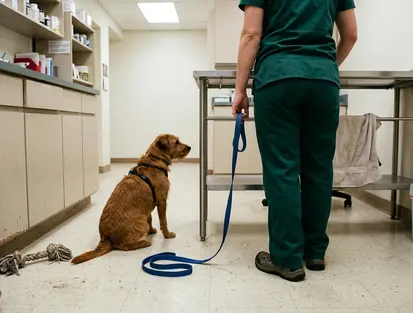
Dogs read us. They feel the tension travel down the leash, hear the catch in our breathing, sense our shoulders climbing toward our ears. You can't fake calm to a creature built to detect it.
So we ground ourselves first. Before you pick up the leash, run a breathing pattern: a 4-second inhale, then a 6-second exhale. The longer exhale is the part that actually settles your system. Do three cycles. Drop your shoulders. Loosen your jaw.
Have a plan for the surprise trigger, too. Know your exit, know your U-turn, know where you'll go if a loose dog rounds the corner. A plan replaces panic with action, and your dog feels that steadiness as clearly as they'd feel your fear.
And on the hard days — the ones where you cry in the car or skip the session entirely, give yourself permission. Setbacks aren't failure. This is slow, tender work, and you're allowed to be a person while you do it. Showing up imperfectly tomorrow beats showing up resentfully today.
Limitations and When to Call a Professional
I'll be straight with you: this guide is educational, and it's not a stand-in for individualized support. Reactivity lives on a spectrum, and some cases need eyes on the actual dog. The mechanics here are humane and evidence-based, but your dog's particular history deserves a real assessment.
Call a certified behavior consultant or veterinary behaviorist if you see red flags:
- Bites, or escalating aggression of any kind
- Your dog can't physiologically recover within 15 to 20 minutes after an exposure
- Zero reduction in reaction intensity after a month or two of consistent, under-threshold practice
That recovery window is the tell. If the nervous system simply won't down-regulate after an event, the problem runs deeper than a home protocol can reach.
Before any of it, rule out medical pain and anxiety with your vet. So much "behavior" is really a body in distress. And whatever path you take, choose people who train humanely — the American Veterinary Society of Animal Behavior position on humane training is a solid compass for what good help looks like.
Key Takeaway: You're not fixing a broken dog. You're teaching a frightened one that the world is safer than they believed — and learning, alongside them, that you can be the calm in the room. That's the whole practice. Show up, stay under threshold, and trust the slow work.







Leave a Comment