
A walk does not really end at the front door. For many dogs, and for the person holding the leash, the body is still out there for a while: scanning the corner, bracing for the barking dog behind the fence, replaying the moment that got messy.
A post-walk reset ritual gives that leftover charge somewhere to go. Not forever. Just for the first few minutes after you cross the threshold, when the nervous system is still listening for what happens next.
What a Post-Walk Reset Ritual Actually Is
A narrow, useful definition
A post-walk reset ritual is a short, repeatable sequence of calming actions performed by the guardian and dog together in the minutes immediately following a walk. The useful window is small: roughly 3 to 8 minutes after coming inside, before the household noise, phone checking, dinner prep, or self-criticism takes over.
This is not the same as general downtime. Downtime might mean unclipping the leash, walking away, and hoping the dog figures it out. A reset ritual is intentional, structured, and shared. It bridges the gap between outdoor stimulation and indoor rest.
Decompression is a body shift, not a vibe
In plain language, decompression means the body begins moving away from sympathetic nervous system dominance, the fight-or-flight gear, toward parasympathetic engagement. That parasympathetic state is often described as rest and digest; a basic medical overview of the physiology of the parasympathetic 'rest and digest' response explains why slower breathing, digestion, and recovery belong in the same neighborhood.
For a dog, that shift may look like softer eyes, slower movement, sniffing, licking, drinking water, or finally choosing to lie down. For the guardian, it may feel like the shoulders dropping half an inch.
Key Takeaway: The ritual is not a reward for a perfect walk. It is a recovery bridge after any walk, especially the wobbly ones.
Why Both of You Carry the Walk Home
Co-regulation travels through the leash
Dogs and their people borrow nervous-system states from each other all day. On a tense walk, the dog may pull, scan, bark, freeze, or lunge. The guardian may shorten the leash, hold their breath, clench their jaw, or start predicting disaster at the next driveway. Neither is being dramatic. Both bodies are trying to stay safe.
That is co-regulation in real life, not a glossy concept. A dog's arousal and a guardian's stress can feed each other, which is why dog-only calming techniques often do not hold if the person walks into the house still vibrating with fear or shame.
The walk can still be in the body
Arousal does not stop the moment the leash comes off. After a heavy trigger-stacking walk, stress chemistry can linger well beyond the event itself. That matters because a dog may look disobedient when they are actually still charged.
Common dog signs include panting after water is available, pacing for more than a few minutes, jumping at ordinary sounds, hovering near windows, or staring toward the street as if the walk is still happening. Guardian signs can be quieter: tight chest, shallow breathing, replaying the incident, embarrassment, or the familiar mental loop of I should have handled that better.
The reset ritual meets both bodies there.
Setting Up Your Reset Space and Cues
Pick boring over beautiful
The best reset space is not a perfectly styled zen room. That idea sounds nice and collapses fast on a rainy Tuesday.
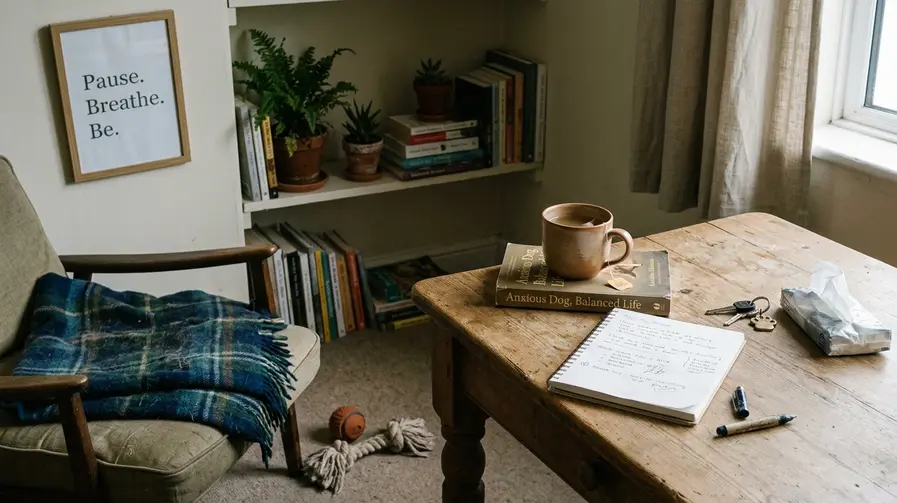
Choose a low-stimulation spot near the entry point, close enough that it is easy to use but calm enough to mean something. Dim lighting helps; a soft, warm glow is plenty. Avoid heavy foot traffic and, if possible, keep the mat at least two rooms away from street-facing windows. If that is not possible, use heavy curtains or choose a corner where the dog cannot keep auditing the sidewalk.
Gather simple anchors
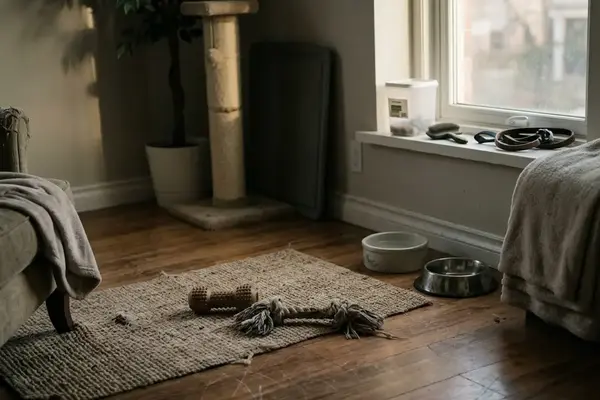
A reset space needs only a few things:
- A mat, towel, or bed that belongs to this ritual.
- Fresh water near the landing spot.
- A prepared lick mat, safe chew, snuffle mat, or scatter-feeding option.
- A chair, cushion, or floor spot for the guardian.
- A lighting cue or repeated phrase that marks the transition.
For some homes, the transition cue is a soft phrase like, settling time. For others, especially after navigating a busy apartment lobby, the clearest cue is physical: harness off, leash unclipped, collar checked, lights lowered. A dog returning to a quiet suburban mudroom may not need as much ceremony. A city dog who just passed two elevators, a lobby dog, and a delivery cart may need the gear removal itself to announce that the working portion of the walk is over.
Pro Tip: Keep the first version almost laughably easy. If the ritual requires opening three cabinets, washing a special bowl, and finding a playlist, it will vanish by Thursday.
The Five-Step Reset Sequence
Step 1: Arrival unwind
Come inside and move slowly. Remove the leash and harness in the same order each time. Offer water. Keep greetings quiet, even if the dog is adorable and you are relieved to be home.
Excited praise can re-spike arousal. The message here is not party time. The message is safe landing.
Step 2: Guardian breathwork
Before asking for connection, regulate the human end of the leash. Try a 4-second inhale followed by a 6-second audible exhale for about 90 to 120 seconds. The longer out-breath is the point.
Audible calm breathing gives the dog information. It says the person is not hunting for danger anymore. It also gives the guardian something concrete to do besides replay the walk.
Step 3: Quiet connection
Offer the dog a lick mat, a slow chew, or a sniffing activity. If the dog seeks contact, use slow strokes along the shoulder or chest rather than quick pats on the head. Sniffing and licking are naturally calming activities for many dogs, and they ask less from the dog than obedience cues do.
Step 4: Shared stillness
Sit nearby without hovering. Look at the floor, soften your hands, and let the dog choose distance. This is often the hardest step for a caring pet parent because doing less can feel like abandonment.
It is not abandonment. It is permission.
Step 5: One-minute reflection
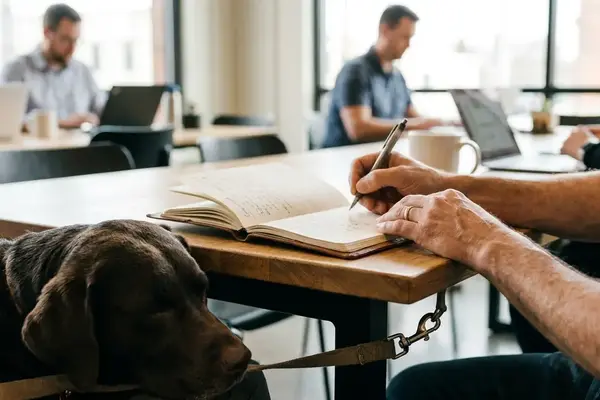
After the dog has begun to settle, take about a minute for a note. Not a courtroom transcript. One line is enough: loud truck at Maple, recovered with lick mat, guardian breathing helped.
Stop there. Reflection can build caregiver confidence; rumination drains it.
Key Takeaway: The order matters: landing, breathing, connection, stillness, brief reflection. Breathwork comes before problem-solving.
Adapting the Ritual for Reactive or Highly Aroused Dogs
When the dog cannot settle at all
Some dogs come home too activated for the standard version. Their paws keep moving. Their mouth gets busy. Their eyes flick toward every sound.
In that case, extend the arrival unwind and lower stimulation further before attempting connection. Skip the petting. Delay the lick mat if food makes the dog frantic. Turn the lights down, close the curtain, and give the dog more physical space.
Let proximity be the dog's choice
Forcing affection is one of the most common mistakes after a reactive walk. A guardian may want to cuddle because they feel guilty or shaken. The dog, still in a highly aroused sympathetic state, may experience that closeness as pressure and respond with more pacing, mouthing, or avoidance.
Reactive dog support often starts with respecting distance. Sit where the dog can see you without feeling handled. If they come closer, receive them quietly. If they stay across the room, that can still be connection.
Use the nose when the body is buzzing
Scatter feeding or a snuffle mat can channel a keyed-up dog's energy into sniffing. A 5 to 10 minute foraging window gives the dog something organized to do without demanding stillness too early.
This ritual supports recovery from everyday stressful walks; it is not treatment for a diagnosed behavioral disorder. If reactivity is persistent, escalating, or aggressive, a qualified certified behaviorist or veterinary behavior referral belongs in the wider care plan.
Warning: Do not use the reset ritual to force calm. The goal is to create the conditions for calm to return.
What It Looks Like on a Hard Day
The messy version is the real version
The walk goes sideways two blocks from home. Another dog appears from behind a parked car. Your dog lunges, barks, twists in the harness, and for a few seconds the whole sidewalk feels too small.
Back inside, the guardian's chest is tight. The leash feels tangled even after it is hung up. The mind starts its old routine: should have crossed earlier, should have trained more, everyone saw that, maybe I am making this dog worse.
Ten minutes can disappear inside that spiral.
The ritual begins late, and it still counts
The guardian remembers the cue and starts again. Harness off slowly. Water down. Light dimmed. No big speech to the dog, no apology tour, no frantic training session in the hallway.
Then the breathing: inhale for 4, exhale for 6. The first few rounds wobble. That is normal. A regulated nervous system is not a performance.
The dog paces for a dozen minutes, maybe 15, before touching the mat. The lick mat gets a few seconds of attention, then a break, then another few seconds. The guardian sits on the floor nearby, one hand resting on their own thigh instead of reaching for the dog.
Eventually, the dog lies down. Not gracefully. Not like a training & play video with perfect lighting. Just down.
That is a win.
Building the Habit and My One Non-Negotiable
Anchor it to the leash
The easiest habit anchor is the one that already happens every time: unclipping the leash. Treat that tactile moment as the start button. Leash off means reset begins.
If journaling & resources help you stay consistent, keep tracking light. A checkmark on a wall calendar for two or three weeks running is enough to see whether the habit is becoming automatic. A one-line note can help, especially in new dog parenthood or while working through reactive dog support, but do not turn the ritual into homework you dread.
The post-walk reset checklist
- Arrival unwind: Remove harness and leash slowly; offer fresh water immediately.
- Guardian breathwork: Complete about 90 seconds of 4-in, 6-out breathing.
- Quiet connection: Provide a prepared lick mat, snuffle mat, or safe chew.
- Shared stillness: Sit nearby without crowding or commanding.
- Brief reflection: Write one useful line, then stop.
For pet parent wellbeing, the ritual works best when it stays small. It should feel like a handrail, not another standard to fail.
If you keep only one step, keep the breathwork. Your regulated nervous system is the clearest signal of safety you can give your dog after a hard walk, and it costs nothing but ninety seconds.








Leave a Comment