
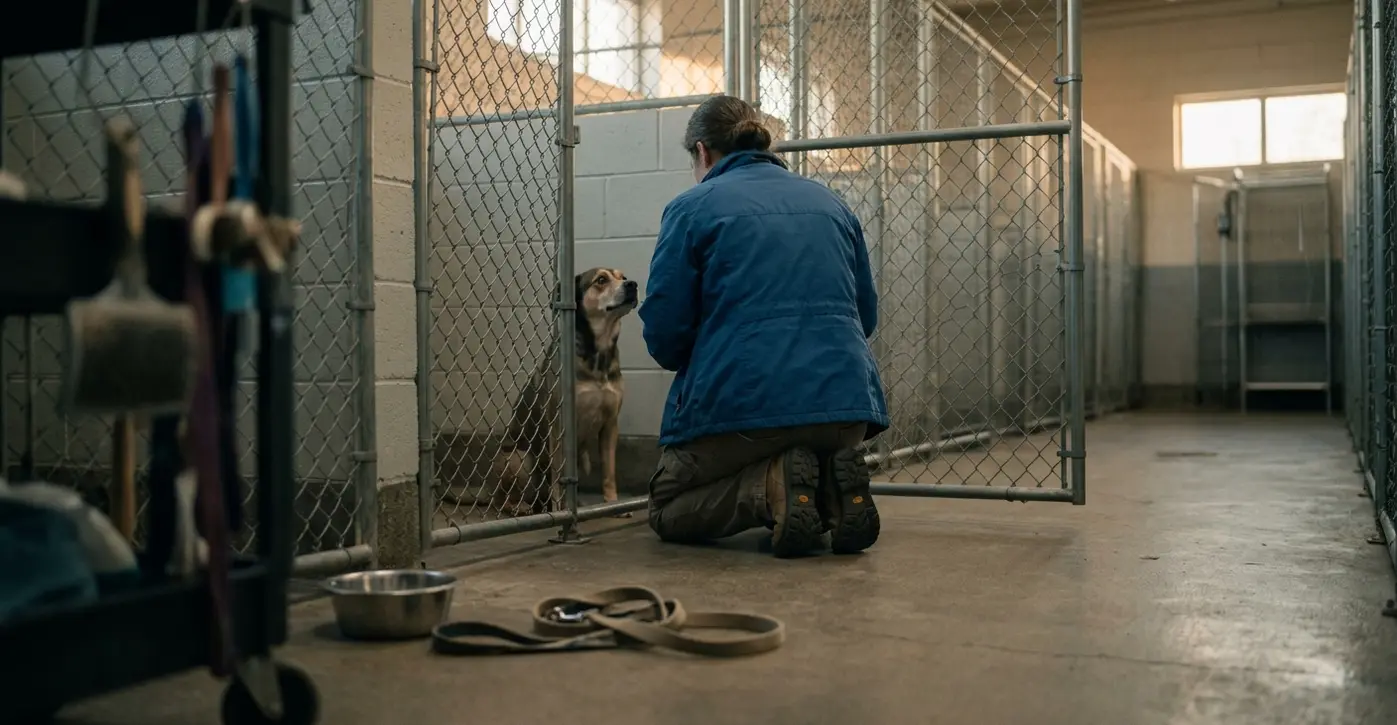
There is a particular kind of silence after a hard walk. The leash is still warm in your hand. Your dog is finally back inside, sniffing the water bowl like nothing happened. You, meanwhile, are replaying the bark, the lunge, the freeze, the look from the person across the street.
This article is for that moment.
The Lie We Tell Ourselves at the End of the Leash
Your dog’s behavior is data, not a verdict
The core truth is simple: your dog’s behavior gives you information; it does not measure your worth.
That can be hard to believe when your body is already reacting. A dog lunges at another dog, barks at a stroller, or plants all four paws in the middle of the sidewalk, and shame can arrive faster than thought. The chest tightens. The face heats. The mind starts writing its little courtroom speech: You should have trained more. You made your dog this way. Everyone can see you are failing.
I’ve felt this at the end of the leash, and the premise itself is flawed.
A dog’s public behavior is not a moral transcript of the person holding the leash. It may reflect fear, pain, distance, arousal, learning history, genetics, or a threshold that got crossed before anyone noticed. Sometimes it reflects a management choice that needs adjusting. That still does not make it a character assessment.
Key Takeaway: A hard moment with your dog may tell you what needs support next. It does not tell you who you are.
Where the 'It's My Fault' Story Actually Comes From
Internet dog culture made the leash feel like a report card
The guilt story did not come from nowhere. Much of online dog culture teaches guardians to read every behavior as evidence of owner quality. Calm dog, good owner. Reactive dog, careless owner. Dog who can nap under a cafe table, disciplined household. Dog who barks from the car window, someone must have done something wrong.
That equation is tidy. It is also incomplete.
Short social media clips often show the polished end of a process, not the months of foundation work that made the clip possible. They rarely show the dog who needed distance first, the handler who left early, the health check that changed the plan, or the quiet repetitions that never looked impressive enough to post.
Temperament is not a parenting grade
A dog with a genetic predisposition to hyper-arousal can struggle in a standard obedience class even when the handler uses careful timing, fair reinforcement, and steady mechanics. That does not mean the guardian lacks leadership. It may mean the learning environment is too stimulating, the class format is too fast, or the dog’s nervous system needs a different entry point.
The same is true when behavior shifts suddenly. A regression in leash walking can come from an undiagnosed gastrointestinal flare-up rather than a lack of consistency at home. Pain and discomfort change thresholds. A dog who felt safe last month may feel raw this month.
Reactivity is a nervous-system response, not a flaw passed from human to dog like a bad habit. Veterinary behavior professionals, including those who discuss the science of reactivity as a fear response, have long pushed against punishment-heavy interpretations of fear-based behavior. That matters because shame often pushes guardians toward harsher choices, right when both dog and human need more steadiness.
Warning: If a training message makes you feel panicked, humiliated, or desperate to prove you are a good person, pause before applying it to your dog.
Behavior Is Information, Not a Performance Review
Read the behavior before judging the person
Here is the practical reframe: replace emotional labels with useful questions.
Instead of, “My dog embarrassed me,” try, “What did my dog react to, how close were we, and what changed right before the reaction?” That question gives you something to work with. Shame gives you nowhere to go.
Training logs show that small changes in distance, timing, and context can change the whole picture. A dog may bark at a trigger when too close, then stay under threshold when given just a little more space. That difference is not magic. It is information.
Three everyday reframes
- A bark at the window: This may be information about visual access, startle, boredom, neighborhood patterns, or a dog who rehearses alarm behavior because the trigger keeps disappearing after the bark.
- A leash lunge: This may be information about distance, frustration, fear, equipment, pain, or a handler accidentally getting trapped between the dog and the exit route.
- A refusal to settle: This may be information about unmet exercise needs, overstimulation, household noise, discomfort, or a dog who has not yet learned what “off duty” feels like.
None of those interpretations require you to insult yourself. They ask you to observe.
Common mistakes that keep shame in charge
- Retelling the event with yourself as the villain.
- Comparing your dog to a calmer dog with a different nervous system.
- Calling the behavior “bad” before identifying the trigger.
- Trying to fix the entire relationship after one rough walk.
When behavior becomes communication, your next step becomes smaller and clearer. You might close the blinds during delivery hours. You might cross the street earlier. You might practice settling after a shorter walk instead of demanding stillness after a chaotic one.
Pro Tip: After a reaction, write three neutral facts before writing any interpretation. “Dog barked. Child ran past. We were near the narrow corner.” Facts help the nervous system come back online.
But Aren't I Responsible? Addressing the Obvious Counter-Argument
Yes, guardians shape outcomes
Responsibility matters. It would be unkind, and frankly unsafe, to pretend otherwise.
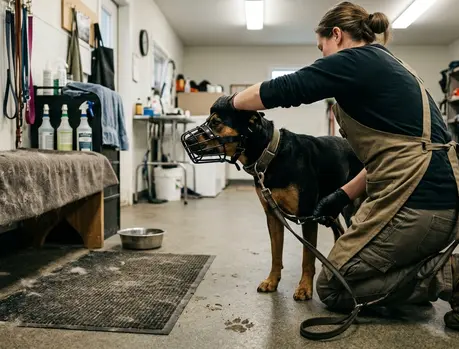
Guardians shape a dog’s daily life through equipment, routines, enrichment, medical follow-up, training choices, and the environments they choose to enter. A person living with a dog who bites, bolts, panics, guards resources, or cannot recover around triggers has real work to do. That work may include a veterinary exam, a qualified trainer or veterinary behaviorist, secure walking gear, medication conversations, muzzle training, or changing the dog’s exposure to public spaces.
Accountability is not the enemy of self-compassion. It is one of its cleanest forms.
Accountability is actionable; worth is not up for review
The problem begins when the sentence “I am responsible for management” turns into “I am defective because my dog struggles.” Those are not the same sentence.
Accountability says, “My dog cannot greet unknown dogs on leash right now, so I will create distance.” Shame says, “A better person would have a dog who could handle this.” Accountability says, “This muzzle needs to be conditioned before we use it in a busy place.” Shame says, “If I need a muzzle, I must have failed.”
One leads to safer choices. The other drains the very steadiness your dog needs from you.
There is a firm boundary here: separating your self-worth from your dog’s behavior does not absolve you of the legal and ethical requirement to use secure management tools, like a well-fitted muzzle or a double-ended leash, when navigating public spaces with a bite-risk dog. This is not a behavior diagnosis; it is a way to keep shame from running the walk.
A better working definition
Try this: responsibility means choosing the next humane, realistic action with the information you have.
That definition leaves room for learning. It leaves room for the dog in front of you, not the imaginary dog you think you should have. It also leaves room for you to be tired, embarrassed, and still worthy of care.
How to Catch the Shame Spiral in Real Time
Use a short script after the hard moment
The shame spiral loves speed. It wants to turn one event into a full identity before you have unclipped the leash.
So slow it down on purpose.
- Name what happened: “My dog barked and lunged when the skateboard passed.”
- Name the likely pressure point: “We were too close, and the sound startled her.”
- Name one adjustment: “Next time, I will step behind the parked cars and feed before the skateboard reaches us.”
- Name one compassionate sentence: “This was hard, and I can still help my dog.”
That script separates the event from the self-story. It does not pretend the walk went beautifully. It also does not allow one rough minute to become a verdict on your entire relationship.
Anchor your body before you solve the problem
Use the ground first. Feel both feet. Let your shoulders drop. Try a single 4-7-8 breathing cycle if that pattern feels comfortable: breathe in for four, hold for seven, exhale for eight. If breath holds make you uneasy, skip the hold and lengthen the exhale instead.
Then say the sentence out loud if you can: “This was a moment, not a measure of me.”
It may feel awkward. That is fine. The goal is not to make the feeling disappear on command. The goal is to interrupt the old pathway before it hardens into, “I am failing my dog.”
What to avoid right after a setback
- Do not review every mistake while your body is still flooded.
- Do not post for advice while shame is choosing your words.
- Do not add a harder training session as punishment for either of you.
- Do not decide your dog’s future based on the worst five minutes of the day.
Later, when your nervous system has settled, you can make a plan. Maybe you choose a quieter route. Maybe you schedule a vet visit. Maybe you practice pattern games at a distance your dog can actually handle. Maybe you ask for help.
None of those choices require self-condemnation.
Key Takeaway: Your dog’s behavior can guide your next step without becoming a story about your worth. You are allowed to be accountable and kind to yourself at the same time.
Citations
- American Veterinary Society of Animal Behavior: professional resources on behavior, welfare, fear, and humane intervention through the science of reactivity as a fear response.













Leave a Comment