
The Ten-Second Front Door Pause That Transforms the Walk
The leash clicks onto the collar. A hand reaches for the door handle. Beside that hand, a dog vibrates with pure anticipation, claws tapping a frantic rhythm on the floorboards. The standard response involves a tug on the leash, a sharp command to sit, and a rising sense of frustration before the walk has even begun. The alternative requires absolutely nothing but stillness. The guardian simply stands in place, takes a breath, and waits for four paws to settle on the concrete.
That 10-second pause at the front door changes the entire trajectory of the walk. The outing starts with a grounded dog and a calm human. This shift happens without a clicker, without a treat pouch, and without scheduling a dedicated training block. Eleven distinct moments just like this one already live inside an ordinary day. They require no extra equipment and take up no calendar space. They simply ask you to use the interactions you are already having.
Why Scattered Micro-Repetitions Beat the Scheduled Obedience Block
Many guardians carry the heavy weight of the 9pm guilt spiral over skipped 20-minute obedience blocks. The day gets away from you, exhaustion sets in, and the planned training session vanishes. Short 10-second scattered repetitions distributed through the day eliminate this cycle of failure. These tiny repetitions happen in the exact contexts where the behavior is actually needed. You practice in the hallway, at the curb, and in the kitchen. The dog learns the behavior in the environment where they will eventually use it, leaving far less translation work for later.
Low-pressure practice protects your mood alongside your dog's emotional state. No scorecard to maintain, no failed session to mourn. These moments function as quiet conversations between you and your dog. The dog learns that checking in with you is reliably worth their time, and you learn to trust your ability to guide them through the day.
Escaping the Perfection Trap
When you abandon the idea of a perfect training session, you open the door to actual progress. A dog learns something in every single interaction, regardless of your intentions. Using those existing seconds builds a foundation of cooperation that a formal obedience class rarely replicates.
Moments 1–3: Building Hesitation at Doorways, Cars, and Gates
Environmental boundaries naturally cause a dog's arousal to spike. Grouping doorways, car doors, and gates together turns these high-arousal thresholds into natural checkpoints for calm behavior.
Moment 1: The Front-Door Pause. Stand completely still at the door. Wait for four paws to remain on the floor or for your dog to glance back at you. Open the door only when you see that hesitation. The opening door itself becomes the reward for their patience.
Moment 2: The Car Door Wait. Place your hand on the car door handle. Release the latch only after your dog stops pushing forward against the crate or the seatbelt tether. This specific pause proves incredibly useful in busy carparks where doors open directly onto moving traffic.
Moment 3: The Gate or Lift Threshold. Implement a stop of a second or two before crossing any major boundary. Repeating this daily builds a default hesitation at every gate. For guardians navigating busy environments, adding a quick street scan for reactive dogs during this pause provides crucial situational awareness before stepping onto the pavement.
Moments 4–6: Capturing Check-Ins and Turning Sniffs Into Currency
Walking a dog often feels like playing the role of a vigilant warden. Shifting your perspective turns you into a collaborative partner. You can use the environment to your advantage rather than fighting it at every turn.
Moment 4: The Free Check-In. Whenever your dog looks up at you unprompted, pay that attention generously. Offer kibble, a piece of cheese, a scratch behind the ears, or a cheerful comment. Nothing else is required. You are simply funding the choice to connect.
Moment 5: The Surprise U-Turn. Change direction mid-pavement without any warning. Celebrate enthusiastically when your dog follows your new path. This functions as loose-lead work disguised as a game. It also provides a genuine, practiced escape route when a trigger suddenly appears ahead of you.
Moment 6: Sniff on Cue. Pair a release phrase like 'go sniff' with the exact lamppost your dog was already heading toward. Turning environmental rewards like lamppost sniffing into handler-controlled currency gives you immense value on a walk. You no longer compete with the environment; you grant access to it.
Moments 7–9: Anchoring Calm to the Food Bowl and the Sofa
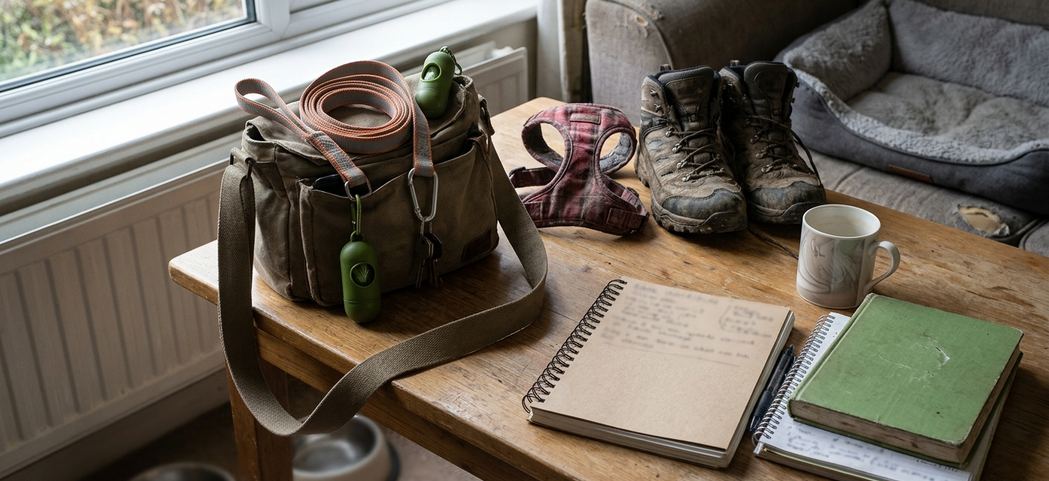
Household routines offer built-in anchors for connection. Capitalizing on these existing daily anchors asks no extra scheduling from a busy household.
Moment 7: The Bowl-Down Pause. Hold the food bowl at waist height. Wait for a sit or simply for stillness. Place the bowl on the floor. That brief pause twice a day, every day of the dog's life, builds immense impulse control without a single raised voice.
Moment 8: The Hallway Hand Target. Present a flat palm on your way to the sofa or the back door. When your dog bumps their nose against your hand, praise them and continue walking. A simple nose touch practiced casually between rooms eventually becomes a highly reliable emergency recall.
Moment 9: The Evening Settle. Reward the dog who chooses their bed while you watch television. Drop a treat quietly between their paws without speaking. Calm behavior gets funded rather than ignored. Speaking often wakes the dog up, so silent delivery keeps the arousal low and reinforces the relaxation.
Funding Quiet Choices at Home
We often ignore our dogs when they are behaving perfectly and only interact when they cause trouble. Reversing this dynamic by quietly rewarding the evening settle changes the entire atmosphere of the living room.
Moments 10–11: Consent Checks and the Post-Trigger Recovery Window
Real-world recovery matters far more than perfect prevention. Dogs will react, environments will surprise you, and mistakes will happen. Knowing how to handle the immediate aftermath of a reaction protects the trust you have built.
Moment 10: Handling During Affection. Touch a paw, an ear, or the collar area for a couple of seconds during affection. Stop immediately and see if the dog asks for more contact. Vet visits and nail trims get easier because the dog learns they have a vote in how they are handled.
Moment 11: The Post-Trigger Reset. After a barking incident, walk a few meters away from the trigger. Offer a scatter of treats in the grass. Let the dog's nose bring the arousal down for roughly a minute and a half before you continue the walk or head home. Sniffing lowers the heart rate and helps clear the adrenaline from their system.
These two recovery moments support baseline decompression; a dog displaying a bite history, escalating reactivity, or sudden behavior changes requires a qualified behavior professional and a veterinary pain assessment before attempting handler-led desensitization. For the average overwhelmed guardian, however, a simple treat scatter provides a reliable way to close a stressful loop.
Stacking Your Chosen Moments Into Existing Daily Habits
Reading a list of eleven tasks easily triggers the exact overwhelm this method was designed to cure. The secret lies in restricted choices. Anchor your chosen moments to habits you already execute without thinking. Use the boiling kettle, the reach for the lead hook, the evening bin run, or the last walk of the night as your triggers to practice.
Picking just three moments for a couple of weeks forces you to start small. Choose one threshold moment, one walk moment, and one home moment. Practice only those three until they feel as natural as locking your front door.
Progress rarely looks like a sudden, cinematic transformation. Progress looks like your dog offering a sit at the front door before you even stop moving. It usually appears in one specific context first. This localized success is completely normal rather than disappointing. The brain builds new pathways slowly, context by context.
Selecting Your First Micro-Repetition for Tonight
Every interaction teaches your dog how the world works. Reframing success as the number of small, paid check-ins per day removes the pressure of achieving a polished, obedience-ring heel. You gain the emotional payoff of feeling competent again after months of feeling behind.
You hold the power to change the tone of your household using seconds you already possess. Look at the routines waiting for you between now and bedtime. Which of these eleven moments will you claim as your own tonight?





Leave a Comment