
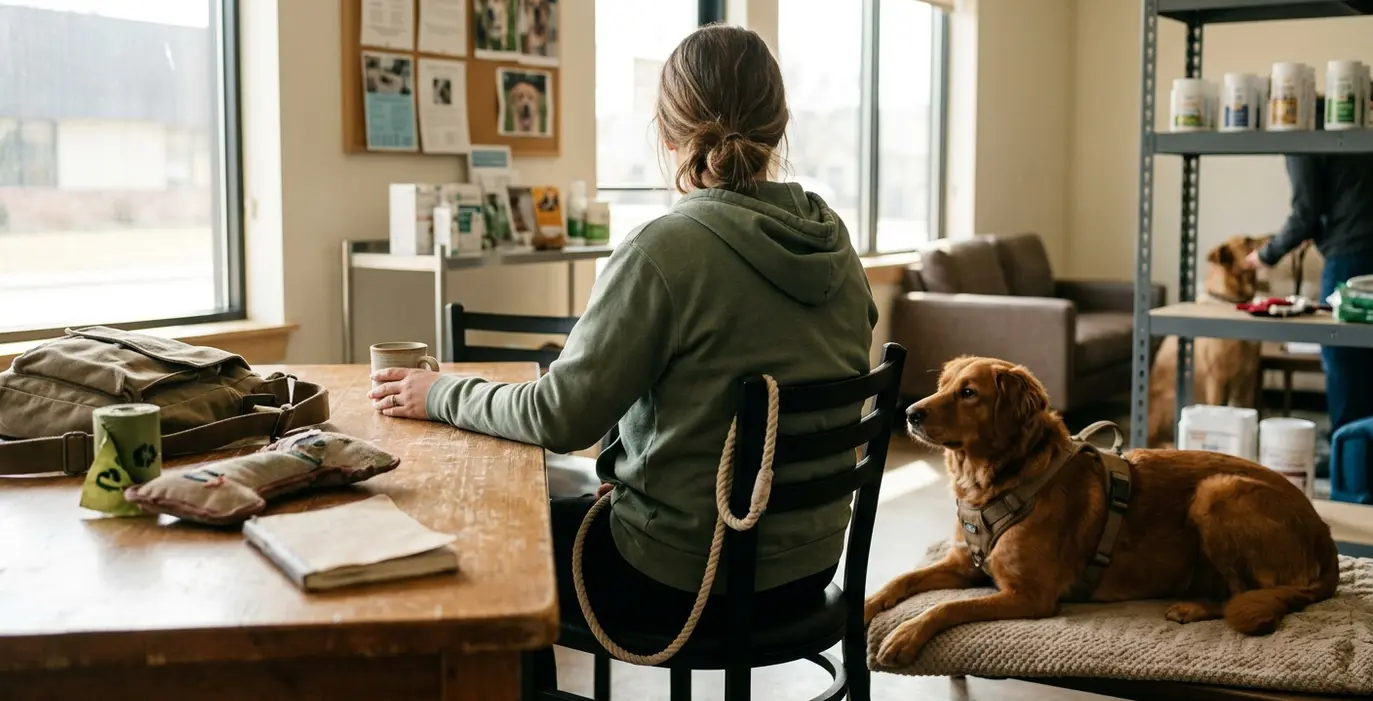
The Quiet Walk Is the Win, Not the Consolation Prize
A walk where a reactive dog never reacts is a successful training session. Full stop.
Many guardians struggle to believe that. They have absorbed the idea that progress requires deliberate exposure: pass the dog across the street, get closer to the cyclist, stay near the playground and “work through it.” Choosing the empty park can feel like chickening out, especially when social media turns busy cafés and crowded trails into evidence of a well-trained dog.
One guardian assessed her dog each morning before touching the leash. On settled days, they walked near home. After restless nights or noisy mornings, she drove to an empty industrial park where the dog could sniff without scanning every doorway. The destination changed because the dog in front of her had changed.
That choice preserved his capacity to learn. It also protected the rest of their day.
The alternative can carry a long tail. A dog pushed through a busy weekend farmer’s market for “socialization” may come home exhausted, remain unsettled for days, and begin reacting to things previously ignored. Stress accumulated during the outing does not disappear when the leash comes off.
Quiet Still Counts
Choosing space gives the dog a chance to rehearse sniffing, checking in, and moving with a loose body. Those are useful behaviors, even when no trigger appears.
The guilt is real, particularly during new dog parenthood. Yet the empty park offers something valuable: a walk both dog and guardian can finish without needing to recover from it.
Why Staying Below Threshold Is Real Training
Threshold is the point where a dog shifts from noticing a trigger to losing the ability to respond thoughtfully. Below threshold, the dog might glance at another dog and still eat, sniff, turn away, or follow a familiar cue. Above it, barking, lunging, freezing, frantic pulling, or total food refusal can take over.
The useful information often appears before the explosion. A hard stare. A stiffened body. A mouth that suddenly closes. Ears held differently. A dog who stops sniffing and leans forward has already started telling the handler that the current distance feels difficult.
Skilled reactive dog support begins there. The handler crosses the road, turns behind a hedge, or moves back until the dog can think again. Distance lowers pressure and creates room for another choice.
Repeated over-threshold encounters keep the stress response ready for action. Calm repetitions let the dog practise a steadier baseline: see something, gather information, remain connected, move on. The learning may look uneventful from the pavement. Inside the dog’s body, it matters.
Planned Management Versus Panic
Intentional trigger management has structure. The guardian selects quieter times, carries food, watches body language, and knows where to retreat. The dog still leaves home, explores, and experiences the world within a workable range.
Panic-driven avoidance tends to shrink life without a plan. Walks vanish, enrichment becomes inconsistent, and the guardian feels trapped indoors. A quieter route should create access to safe movement, training & play, and decompression.
For dogs with bite histories, route-level guidance has clear limits; an individual assessment should shape the safety plan.
Redefining What Progress Actually Looks Like
Busy environments make a poor universal scorecard. A dog can endure a crowded sidewalk while staying tense from nose to tail. Another dog can walk a quiet loop, recover smoothly from a surprise, and return home ready to rest. The second picture often shows more functional progress.
Watch for the quieter changes:
- A softer body after spotting movement at a distance.
- A faster recovery following a bark, dropped bin lid, or sudden pedestrian.
- Willingness to take food without snatching.
- Voluntary check-ins that happen before the leash tightens.
- A return to sniffing after a startle.
- The ability to turn away and continue walking.
Recovery deserves special attention. Many guardians begin by counting how many dogs they can pass without a reaction. That count misses the dog who startles, shakes off, accepts a treat, and settles again. The recovery itself shows the nervous system finding its way back.
Progress may appear in brief moments: the mouth softens sooner, the leash loosens earlier, or the dog resumes exploring after a trigger moves away. Those observations belong in a simple journaling practice. A short note such as “saw dog, turned behind car, sniffed again” provides more useful context than “good walk” or “bad walk.”
Track The Return
Record what helped the dog recover, including distance, visual cover, movement, food, or a chance to sniff. The pattern matters more than a flawless outing.
How to Design a Quieter Route on Purpose
A peaceful walk usually starts before the front door opens. Route design turns hope into a practical plan.
- Scout the timing. Check the area during early morning, between commuter periods, or later in the evening. Bin collection, school traffic, delivery vans, and popular dog-walking times can transform the same street.
- Find decompression spots. Look for grass verges, open parking areas, wide paths, or quiet corners where the dog can lower their head and sniff.
- Mark the traps. Blind corners, narrow pavements, dead-end streets, and building exits reduce room to move. Know where they are before the dog meets a trigger there.
- Choose escape routes. Identify a driveway to cross into, a side street to turn down, or an open area where distance can be added quickly.
- Set a clear finish point. End after a calm check-in, relaxed sniff, or easy stretch of walking. Distance offers little value once the dog’s coping capacity has run out.

Terrain can do much of the work. Parked cars interrupt a dog’s sightline. Thick hedges provide cover. Curved paths reveal the environment gradually. Even a broad tree trunk can buy enough time to turn and create space.
Context changes what “quiet” looks like. In a dense apartment complex, the workable route may be an empty concrete parking garage late at night. In a suburban area, it may be a nature trail before local walkers arrive. Both can support decompression when the setting feels safe and predictable.
Short outings also have a place. A brief sniff session on a long line can serve the dog better on a high-stress day than a long neighborhood march ending in a meltdown. The done point should arrive while both ends of the leash still have choices.
Protecting Your Own Nervous System, Too
Guardians often leave the house already braced for the next loose dog, slammed gate, or stranger who says, “Mine is friendly.” That vigilance is exhausting.
Dogs can notice changes in posture, movement, breathing, and leash pressure. This should never become another reason to blame the person holding the leash. Pet parent wellbeing affects the walk because the guardian also needs enough capacity to make decisions, scan ahead, and move without panic.
A Doorway Reset
Before opening the door, pause. Let the shoulders drop, soften the knees, and check the leash grip. Then look outside before inviting the dog through. This small routine creates a cleaner start and may reveal that the planned route is already too busy.
Some days call for skipping the walk entirely. A food search, shredding activity, scatter feed, gentle play routine, or sniffing session in a quiet shared space can meet immediate needs at home. Missing a neighborhood loop does not erase previous work.
“We only managed a few minutes” can become “We stopped while everyone was still coping.” Sustainable pacing protects the relationship. It also leaves enough emotional energy for life beyond the dog, which matters when reactive dog support has begun to occupy every thought.
End With Capacity
Return home before either participant is depleted. A walk that preserves energy for rest and connection has done useful work.
When Quiet Walks Alone Aren’t Enough
Management creates a foundation. Some dogs need a broader plan that includes behavior work, environmental changes, veterinary care, or all three.
Escalating intensity deserves attention. Redirected leash biting, attempts to bite the handler, prolonged hypervigilance at home, repeated inability to eat outside, or a shrinking quality of life can signal that the current plan is no longer carrying enough of the load. Human wellbeing belongs in that assessment too. A guardian who feels frightened, isolated, or unable to meet basic daily needs requires support around the plan.
A useful record captures the setting, trigger, early body-language changes, response, recovery, and what helped. Keep the wording plain. “Dog appeared from doorway; body stiffened; leash bite followed” gives a qualified behavior professional more to work with than a label such as “went crazy.” A consistent daily log over a sustained period can reveal whether incidents are intensifying or clustering around pain, poor sleep, busy days, or particular locations.
A veterinary visit can investigate pain and other physical contributors. Discomfort may lower a dog’s tolerance long before an obvious limp appears. A certified behavior professional can then assess safety, handling, trigger distance, and realistic training steps for that individual dog.
Quiet walks remain useful during this process. They reduce unnecessary rehearsal and give the household breathing room while a fuller plan takes shape.
Plan Your Next Quiet Walk Today
Choose a single low-traffic route before the next outing. Pick a quiet time window, identify an easy retreat point, and decide what calm ending will send you home: a voluntary check-in, loose-leash sniffing, or a relaxed turn away from movement.
Leave the distance goal behind. When that calm moment appears, finish the walk instead of squeezing in another block.
Once home, write down one non-reaction win and the condition that made it possible. Start that evidence file today; choosing quiet is choosing progress.






Leave a Comment