
Measuring Connection Through Shared Space
Building a life with a new dog requires showing up consistently while releasing the pressure of immediate physical affection. During the first week of adoption, a dog holding roughly four feet of physical distance is actively participating in the relationship. They are observing, calculating safety, and learning the rhythms of a new environment. Lying across the room with their back half-turned represents a deliberate choice to share space.
Adopters often feel a deep ache when a new dog avoids touch or retreats to a corner. That discomfort belongs entirely to the human nervous system. Acknowledging this reality allows the feeling to exist without requiring the dog to solve it through forced interaction. True connection begins by honoring the dog's current spatial needs.
Identifying Physical Consent and the Three-Second Rule
Consent in a home setting means the dog can leave, the dog can decline, and nothing bad happens when they do. Establishing this dynamic early prevents behavioral fallout later.
These low-pressure methods are designed specifically for healthy, cautious, or shut-down dogs adjusting to a new home; sudden avoidance in a previously confident dog requires a veterinary assessment first, as pain frequently mimics fear.
The three-second physical pause test offers a simple way to read a dog's comfort with touch. You initiate contact briefly for three seconds, stop completely, and watch the dog's response. If they re-orient toward your hand, nudge you, or lean in, they are requesting more. If they look away, lick their lips, or drift away, they are declining.
Small affirmative signals often go unnoticed by anxious pet parents. Watch for a loose sigh-and-settle, choosing to lie down in your half of the room, eating within about six feet of the guardian, or offering a soft blink in your direction. These micro-behaviors indicate a nervous system beginning to down-regulate.
Establishing Presence Without Transactional Pressure
Removing transactional pressure tends to speed up acclimation. You can build profound trust simply by existing in the same room without making demands.
Method 1: Parallel Sitting
Sit on the floor at the far edge of the room for ten minutes of parallel sitting. Angle your body sideways to avoid confrontational frontal alignment. Read a book aloud in a soft voice or scroll quietly on your phone. Make zero eye contact and completely avoid calling the dog's name. This exercise proves that your proximity does not equal a demand for interaction.
Method 2: The Boring Human Hour
Select one predictable hour each day to deliberately ignore the dog. Go about your normal household tasks, watch television, or work at your desk while acting as if the dog is invisible. When proximity stops predicting demands, the dog learns your presence has no hidden cost attached.
Method 3: Anchor Points
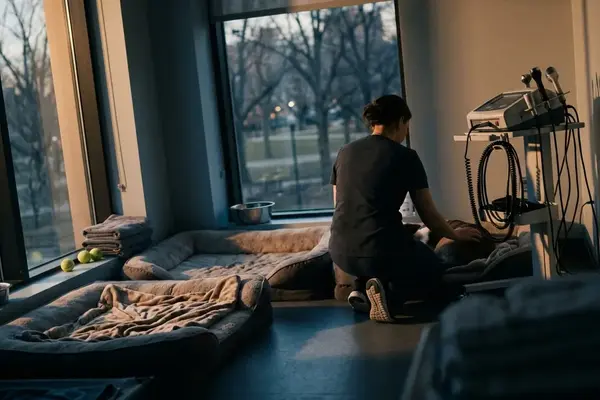
Give the dog two or three designated safe stations throughout the main living areas. This might include a crate with the door secured open, a plush bed tucked behind an armchair, or a mat positioned quietly by the hallway. Providing multiple anchor points makes approaching and retreating both easy and obvious for the dog.
Tracking Latency Drops: Measure trust through the latency of a loose sigh-and-settle rather than forced couch cuddles. A dog settling in five minutes instead of twenty is making measurable progress.
Building Trust Through Scent and Foraging
Food and scent offer powerful pathways to connection that bypass the need for physical touch.

Method 4: Floor Scatter
Toss a small handful of kibble or soft treats away from your body, aiming for the floor rather than offering them from your hand. We must respect the ethical boundary of not forcing a space-seeking dog to trade safety for calories via hand-feeding. Floor scatters allow the dog to eat in your presence without entering your immediate reach zone.
Method 5: The Sniffari
Take the dog on a fifteen-minute walk on a long line with absolutely no destination in mind. Let the dog pick every turn, every patch of grass, and every lamp post. Optimal foraging and deep sniffing physically lower arousal levels. The shared route becomes a collaborative activity rather than an obedience drill.
Method 6: Scent Swap
Leave a worn t-shirt on the dog's bed. Allow them to investigate your smell independently while you are in another room. On rainy days, pair this with a snuffle mat or a cardboard box filled with crumpled paper and hidden kibble to encourage indoor foraging.
Using Predictable Routines to Communicate Safety
A dog's nervous system requires environmental predictability to deactivate hyper-vigilance before it can process affection.
Method 7: Same Order, Same Time
Run meals, potty breaks, and settle time in the same daily sequence for at least two weeks. When the dog can predict the exact flow of the day, they stop scanning you constantly for clues about what happens next. Reviewing ASPCA dog care guidance provides a solid foundation for structuring these daily requirements safely.
Method 8: Narrate Your Movement
Say a soft, consistent phrase like "I'm getting up" before you stand, open a door, or walk past the dog's bed. Announced humans are far less startling than sudden ones. This verbal telegraphing prevents the startle response and keeps the dog below their stress threshold.
Method 9: The Window Shift
Sit together at a window, on a porch step, or in a parked car with a clear view. Watch the world go by in complete silence. Co-observation serves as a genuine social activity for dogs, delivering the benefits of companionship minus the pressure of touching.
Establishing Baseline Safety: Consistent daily routines do the heavy lifting of communication, allowing the dog to rest rather than anticipate.
Well-Intentioned Actions That Delay Adjustment
Guardians often create real behavioral setbacks by rushing the intimacy timeline.
Cornering with kindness happens frequently in the early days. Sitting between the dog and their only exit, or blocking a doorway to offer reassurance, traps the animal. A dog must always have a clear, unobstructed path to leave the room.
The visitor parade derails early progress. Inviting friends and extended family over to meet the new dog during the first two weeks of adoption overwhelms their coping mechanisms. Social exposure cannot substitute for foundational trust-building with the primary household members.
Over-touching during sleep or while the dog rests on their bed violates basic consent. A sleeping dog has no ability to decline interaction. Let sleeping dogs lie, ensuring their bed remains an absolute sanctuary from human hands.
Protecting The First Fortnight: Keep the home environment entirely closed to outside visitors for the first two weeks to prevent nervous system burnout.
Implementing Your First Seven-Day Protocol
Choose Method 1, Parallel Sitting, and execute it at the exact same time each day for seven consecutive days. Set a timer for ten minutes, put your phone on silent, sit sideways on the floor, and do not call the dog. Log one line per day in a notebook recording exactly where the dog settled and how many minutes it took them to lie down. Distance and latency are the two measurable trust metrics available to you right now. Add a second method from this list only when this first routine becomes completely boring for both of you.











Leave a Comment