
From Husbandry Crates to Tug Ropes: Where the Consent Idea Started
Consent-based play borrows its basic structure from animal husbandry training. In zoos, aquariums, and veterinary settings, handlers taught animals to signal readiness before care began. A chin placed on a rest, feet stationed on a platform, or a voluntarily presented paw could open the procedure. When the animal withdrew that behavior, the handler stopped.
The important shift concerned cooperation. Handlers began treating it as a behavior that could be taught and observed rather than something restraint could produce on demand.
That thinking moved into companion-dog cooperative care through nail trims, ear drops, examinations, and harness fitting. More recently, guardians have carried the same principle into training & play. Some initially leaned on familiar obedience cues to contain excitement. Those cues often hid the dog's emotional state, so attention shifted toward voluntary behaviors that showed an active choice to begin.
Choice Becomes Visible
In play, consent is observed through invitation, continued participation, and an uncomplicated route out. The guardian's job is to make all three easy to see.
Yes, Wait, and No Thanks: The Three Answers Dogs Already Give
Dogs rarely deliver a single universal play signal. Each has a personal vocabulary shaped by temperament, learning history, energy, and the room around them. A useful reading starts outside the game: watch how the dog carries the mouth, tail, spine, and weight while relaxed. That baseline makes a change in arousal easier to spot.
An Invitation to Continue
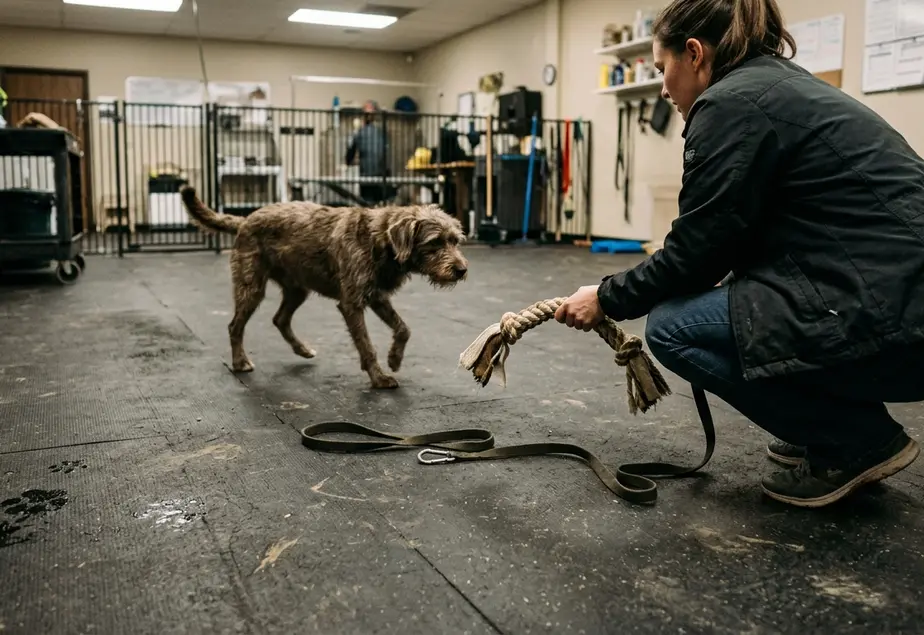
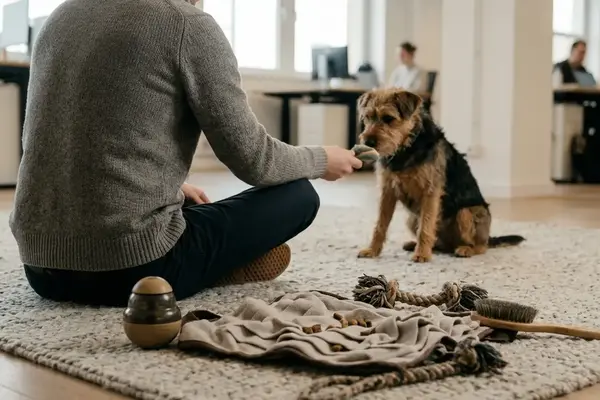
A play bow, bouncy approach, soft open mouth, toy placed in a lap, or exaggerated looping movement may invite action. Re-engagement after a genuine break carries particular weight because the dog had room to leave and chose to return.
A Moment of Ambivalence
Lip licking between bouts, sudden scratching, ground sniffing, slower tail carriage, or turning the body away by roughly 15 to 30 degrees can mean the dog needs more space or time. One signal deserves curiosity. Several arriving together deserve a pause.
A Clear Exit
Walking away, lying down with the toy, going still, moving behind furniture, or heading to the water bowl ends the invitation. A hard stare or freeze around the toy raises a separate safety concern and should end the session immediately.
Step One: Give Your Dog a Way to Say “Go”
The easiest start signal usually comes from something the dog already does. A natural nose nudge suits one dog; another may sit and look at the toy, tap a leg with a paw, or step onto a mat. Choosing an effortless behavior keeps the signal available even when excitement rises.
- Build it cold. Practice in a quiet room without a toy moving through the dog's field of view.
- Mark the chosen behavior. Reward in the range of 10 to 15 calm repetitions so the dog can offer it deliberately.
- Attach play. Present the toy without animating it. As soon as the start behavior appears, begin approximately three to five seconds of play.
- Stop cleanly. Let the toy become still before waiting for another start signal.
Timing matters more than verbal enthusiasm. If the guardian waits several beats before making the toy come alive, the connection between the dog's action and the start of play becomes muddy.
Step Two: Install a Pause That Keeps the Game Safe
A pause should feel predictable and emotionally quiet. Pick one neutral word that has no history as an obedience command. Say it at conversational volume, allow the hands and shoulders to settle, and make the toy completely dead. With tug, release tension. With fetch, lower the throwing arm.
Teach this during mild excitement. After a short bout, say the marker and hold just about two seconds of stillness. The dog may remain nearby, look toward the toy, shake off, sniff, or step away. All of those responses provide useful information.
Once the dog moves smoothly between activity and stillness, the same pause can be introduced during livelier play. Starting at peak intensity asks too much too soon.
Watch the Throwing Arm
When a dog repeatedly fails to re-initiate after the pause, inspect the human posture first. A cocked arm keeps promising another throw. Lowering the toy fully gives the dog a real decision.
Step Three: Actually Let Your Dog Leave
This step asks more of the human nervous system than the dog. A guardian may feel rejected, worry that the game was done badly, or coax the dog back with a bright “come on.” That social pressure makes the exit harder to read.
After a bout, step back, drop both hands to the sides, and wait five full seconds. Keep the toy quiet. Avoid calling the dog's name, leaning forward, or following.
If the dog returns with loose movement or repeats the established start signal, play can resume. If the dog drinks, settles, sniffs elsewhere, or stays away, the session has reached a useful ending. Re-initiation is consent data; the absence of it is data too.
Honoring that answer can also protect pet parent wellbeing. The guardian no longer has to guess whether more excitement will make the dog happier. The dog's next movement supplies the answer.
The Five-Minute Session, Bout by Bout
In hands-on practice, a short structure keeps observation possible before arousal or cognitive fatigue takes over. For the first two weeks, use one toy in a defined space without other dogs present. Set a nearly five-minute timer. Treats are optional.
- Wait for the dog's established start signal.
- Play for three to five seconds.
- Say the neutral pause cue and make the toy still.
- Hold two seconds of genuine stillness.
- Allow the dog to re-invite play before beginning again.
- Repeat for four to six bouts, stopping sooner if the dog exits.
The Longer Midpoint Check
After the third bout, extend the wait to five full seconds. This small diagnostic break shows whether the dog still wants the same game at the same intensity. It also helps the guardian notice personal habits such as hovering, toy-waving, or filling silence with cues.
End while the dog can transition comfortably toward rest. Finishing before arousal peaks builds a cleaner rhythm between engagement and recovery, which can be especially helpful in new dog parenthood.
When the Routine Stalls: Arousal, Guarding, and Reactive Dogs
A dog who cannot pause needs an easier version of the game. Shorten each bout, reduce the toy's movement, and move to a lower-stimulus room. Rebuild the pause there before changing the toy or adding duration. Isolating one variable makes the dog's response readable.
When Re-Engagement Disappears
If the dog repeatedly declines another bout, examine the setting. The toy may hold little value, the play may last too long, or activity outside the room may be consuming attention. Change one element at a time. For reactive dog support, visual or auditory triggers beyond the play space can matter more than the toy itself.
When the Body Freezes
A freeze, hard stare, or stiffening when a person reaches toward the toy calls for an immediate stop. Do not test the exit again, reach for the object, or attempt to train through the tension. This framework assumes safe, non-aggressive household play; resource guarding requires assessment by a qualified behavior professional.
Guarding Ends Testing
The five-second exit check loses its value when a dog is guarding a resource or managing outside stress. Create distance and bring the session to a quiet close.
Tonight’s Baseline: One Toy, Three Bouts, One Real Exit
The first session works best as observation rather than a lesson packed with new rules. Take one familiar toy into a quiet room. Hold it still and wait for any deliberate movement toward it, such as a nose touch, focused sit, or paw tap. Animate the toy only after that movement appears.
Play exactly three short bouts, placing a calm pause between them. After the third, lower the toy to the side, drop the hands, and wait five full seconds without speaking.
Whatever the dog does next becomes the baseline. Write two lines in a journaling & resources notebook: the start signal that opened the game and the exit or re-entry signal that followed the final pause. Repeat this same observation for seven consecutive days, beginning tonight with those two lines.





Leave a Comment