

Quick Nav
- An Envelope, a Sleeping Terrier, and Eleven O'Clock
- Picking a Helper Who Respects Your Dog's Rules
- What Belongs on the Fridge Sheet
- A Walk-and-Dinner Rehearsal Two Weeks Out
- The Guilt of Handing Over the Leash
- Text Your Helper Today and Book a Calm Weekday
An Envelope, a Sleeping Terrier, and Eleven O'Clock
It's 11:00 p.m. on a Friday. Her sister arrives at 8:00 a.m. to take over for the weekend, and this will be the first 48 hours away in 12 months. She stands at the kitchen counter writing care notes on the back of a utility envelope because it was the closest paper in reach.
Her reactive terrier is asleep against the front door, curled into the spot where he can hear everything. She keeps adding lines. Don't let him see the mail carrier. Check the driveway before you open the door. If you hear tags jingling down the block, turn around. The envelope runs out of room, so the notes start climbing up the margins.
Under that scramble sits a quieter worry. She trusts her sister. What scares her is how much of her dog's safety lives only in her own head.
Daily management habits get absorbed into your body. You pause at the blind spot by the driveway before turning the deadbolt. You hear metal collar tags a block away and change direction without thinking about it. None of that feels like a rule until someone else has to hold the leash, and then it all comes pouring out at midnight.
This piece walks through three things, in order, so the handoff stops being a late-night brain dump: choose the right helper, write the care down on one page, and rehearse it once while nothing is at stake. You can do all three before your next trip is even on the calendar.
Picking a Helper Who Respects Your Dog's Rules
Most guardians start with the obvious filter: who's free that weekend? That's a fair first cut. It shouldn't be the deciding one.
Ask around in any reactive dog support group and you'll hear the same advice repeated: pick someone who loves dogs. It's warm advice, and it's half right. Love for dogs can make a helper worse with a reactive dog, because the instinct is to befriend, to soothe, to fix.
The sharper question is whether this person can follow your dog's routine exactly as written, even when it looks fussy to them. Picture two candidates. One is a well-meaning relative who insists your terrier "just wants to say hi" and plans to bond with him over the weekend. The other is a calm friend who will walk in without making eye contact, hold a 15-foot buffer on the sidewalk, and never once ask why. The second person is your helper.
Fit questions worth asking honestly
- Has this person met your dog more than once? Aim for 2 to 3 low-pressure visits before you hand over house keys.
- Do they follow the entry protocol without turning it into a negotiation?
- Will they cross the street or turn around to keep a 15-to-20-foot buffer from triggers, even if it feels silly on a quiet block?
- Do they take a boundary personally when your dog doesn't warm up to them?
- Will they tell you when something went wrong, instead of smoothing it over?
My own read: the helper who seems a little boring with your dog is usually the right one. Boring keeps arousal low.
Know Your Safety Line
If your dog has a documented bite history, or triggers severe enough that a single gear failure creates real risk, an informal family or neighbor handoff is no longer safe. That's the point to book a credentialed behavior professional or a secure boarding facility.
What Belongs on the Fridge Sheet (and What Stays Off It)
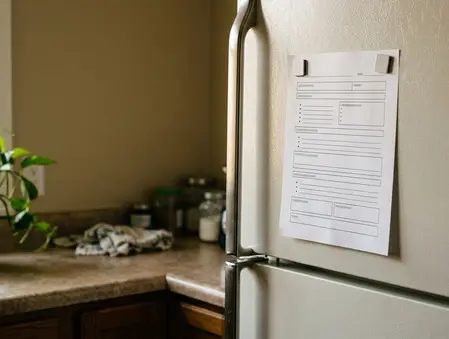
The care sheet moves knowledge out of your head and onto the fridge. Its whole value is that your helper never has to guess.
We first tried a multi-page binder covering every back-story detail of the dog's reactivity. Helpers froze mid-routine, flipping pages with a leash in one hand. That format went in the drawer. A single-sided printed page on the fridge, with a PDF copy sent to the helper's phone, keeps the emergency actions visible when they matter.
The blocks, and why each one earns its spot
- Contacts: your number, the backup helper, your vet clinic's name and number, and the nearest after-hours emergency vet. Nobody should be searching for these in a panic.
- Feeding: amount, timing, where the bowl goes, and whether your dog needs space while eating.
- Medications: name, dose, time, and how you give it (wrapped in cheese, hidden in a meatball).
- Walk route and gear: which harness, which leash, which direction, and the buffer distance from triggers.
- Known triggers: mail carrier, loose dogs, the yard with the barking fence. Keep it short.
- If-this-then-that lines: two or three plain contingencies for the hiccups most likely to happen.
That last block is where the envelope gets translated. The invisible habits from the opening become lines like these:
- If you hear collar tags or see a loose dog ahead, turn around and walk the other way. Don't wait to see if it's friendly.
- If he skips dinner, offer it once more in an hour, then pick it up and text me.
- Before opening the front door, look through the side window at the driveway first.
Two or three lines is plenty. Anything more and you're back to the binder.
A Walk-and-Dinner Rehearsal Two Weeks Out
The practice handoff is short: a 60-to-90-minute window that covers one short walk and a single meal. Your helper runs it using only the care sheet. Schedule it 14 to 21 days before you actually leave, which gives you room for a second familiarization visit if the first one surfaces gaps.
How to run it
- Walk through the sheet together indoors. Point to the leash hook, the food bin, the pill organizer, the side window by the driveway.
- Do a dry run of the door routine without the dog going anywhere: harness on, check the driveway, step out.
- Leave the property. Stay within a 10-minute drive and keep your phone on.
- Let the helper do the walk and the meal alone.
- Come back for a 15-minute debrief. What was unclear? What did your dog do that surprised them?
Where these rehearsals tend to slip
The most common slip is staying to shadow the walk. It feels supportive. For your dog, it muddies who's directing the routine, and you learn very little about how they'll do together. Leaving after the indoor walkthrough gives you an honest picture.
The second is editing the care sheet out loud instead of on paper. If you hear yourself saying "oh, and also," write it down before the helper leaves.
If the trial goes sideways
A wobbly trial is useful information. If your dog wouldn't settle, book that second familiarization visit. If the helper skipped a step, ask which line on the sheet was confusing and rewrite it. If the helper brushed off a rule entirely, that tells you something about fit, and you still have two weeks to find someone else.
The Guilt of Handing Over the Leash
Let's name it plainly: leaving your dog can feel like abandoning them. Many devoted dog moms feel this, and it runs especially strong with reactive or anxious dogs, where caregiving can turn into a full-time vigilance job with no shift change.
Your needs belong inside your dog's care plan. A rested guardian brings more patience, steadier energy on walks, and a calmer presence at the door. Dogs read that. Pet parent wellbeing feeds directly into the training and play you share once you're home.
Ways to loosen the grip
- Agree on fixed check-in times before you leave. Two scheduled photo or text updates a day, such as 9:00 a.m. after breakfast and 8:00 p.m. at settle-in, beat open-ended messaging.
- Stay off the front-door camera between check-ins. The fixed windows turn vague anxiety into a clear boundary, and they keep a rest break from becoming remote surveillance.
- Journal the worry before the trip. Write down what you're afraid of, then circle anything the care sheet already handles.
- Plan your first hour back. A quiet decompression walk together gives the guilt somewhere to land.
Rest Counts As Care
Two set check-ins a day give you something to look forward to and a reason to put the phone down between them. Your helper will appreciate the predictability too.
Text Your Helper Today and Book a Calm Weekday
Here's where I land, without hedging: do the practice handoff this month, while you're rested and no trip is pending. A plan tested on an ordinary Tuesday holds up on a hard week.
When a departure date is looming, urgency makes you overlook a helper's small protocol slips. You tell yourself it was probably fine. Run the trial with no deadline attached and you see those slips clearly enough to fix them.
Think back to that envelope at 11:00 p.m., notes crawling up the margins while the terrier slept by the door. The goal is a single page on the fridge and a helper who has already walked the route, checked the driveway, and served dinner once.
Send One Text Now
Pick one person from your fit list. Text them today and propose a 60-minute mid-week practice block within the next 30 days. That single message does more for your next weekend away than any amount of midnight note-writing.








Leave a Comment